Self-Regulation Lab For Self-Awareness
What if your stress, anxiety, or chronic symptoms are not random—but the result of patterns your brain and body have learned over time? Many people struggle because they lack self-awareness, and without it, true self-regulation becomes difficult. As a result, the same cycles repeat: tension builds, symptoms appear, and the body stays stuck in survival mode.
The good news is that self-regulation is a trainable skill. With the right approach, you can improve your self-awareness, develop effective self-regulation techniques, and take real steps toward self-improvement and sustainable self-care. This is where modern digital health solutions and structured training methods make a difference.
Welcome to the Self-Regulation Lab—a space designed to help you understand what self-regulation is and how to apply it in real life. Here, you will discover practical methods, tools, and guidance inspired by both science and self-help principles, including insights commonly found in leading self-help books. Whether your goal is to manage migraines, reduce anxiety, or improve your daily performance, this is where your journey begins. With the right tools and training, change becomes possible.
No more guessing. No more suffering.
Here you will learn:
- how to track your patterns,
- how to identify your root cause,
- physical techniques you can use today, and
- how biofeedback can accelerate your progress.
Table of Contents
ToggleWhat Is Self-Regulation?
Self-regulation is the ability to recognize and influence your internal state—your thoughts, emotions, and physical responses—in a conscious and adaptive way. In simple terms, it is the skill of noticing what is happening inside you and learning to respond rather than react.
At the core of self-regulation lies self-awareness. Without awareness, the brain and body operate on automatic patterns. These patterns are shaped by past experiences, stress, and repeated reactions. Over time, they can lead to persistent cycles such as anxiety, tension, or even chronic conditions like migraines.
When self-regulation is weak or untrained, the nervous system tends to stay in a reactive mode. Small triggers can lead to strong responses. The body may remain in a state of heightened alertness, often described as “survival mode.” This is why many symptoms feel uncontrollable—they are not consciously guided.
However, self-regulation can be developed. Through consistent practice and the right self-regulation techniques, you can learn to:
- recognize early signals of stress or imbalance
- interrupt automatic reactions
- shift your physiological and emotional state
- build more stable and adaptive responses over time
This process is not about suppressing symptoms. Instead, it is about understanding how your system works and gradually training it to function more efficiently. This is where approaches from modern digital health and evidence-based self-help methods become powerful tools for change.
Why Self-Regulation Matters
Self-regulation is not just a skill—it is the foundation of how you experience and respond to life. When it is underdeveloped or disrupted, even small challenges can feel overwhelming. Over time, this imbalance affects not only your mental state but also your physical health and overall quality of life.
At the center of this process is self-awareness. When you are not aware of your internal signals, your reactions become automatic. Stress builds without notice. Emotions escalate quickly. The body responds as if it is under constant pressure. This is how temporary discomfort can gradually turn into chronic patterns.
Without effective self-regulation, the consequences often appear in different areas.
Mental and Cognitive Impact
You may notice difficulty concentrating, constant overthinking, or mental fatigue. This directly limits your ability to focus, make decisions, and perform at your best.
Emotional Impact
Emotional responses become stronger and harder to control. Anxiety, irritability, or mood fluctuations may seem unpredictable, but they often follow learned patterns that repeat over time.
Physical Impact
The body reflects what the nervous system experiences. Persistent tension, headaches, and migraines are common signs that regulation is not functioning optimally. In many cases, these symptoms are not random—they are the result of ongoing physiological stress.
Behavioral Patterns
You may find yourself reacting instead of choosing—avoiding situations, procrastinating, or feeling stuck in habits that are difficult to change. This is where the gap between intention and action becomes most visible.
The good news is that all of these patterns can be influenced.
By developing self-regulation through structured self-regulation techniques, you begin to change how your system responds. Instead of reacting automatically, you gain the ability to pause, adjust, and guide your internal state. This is the foundation of lasting self-improvement and effective self-care.
In today’s world, this process is supported not only by traditional methods but also by modern digital health approaches that enable you to train your brain and body more precisely and measurably.
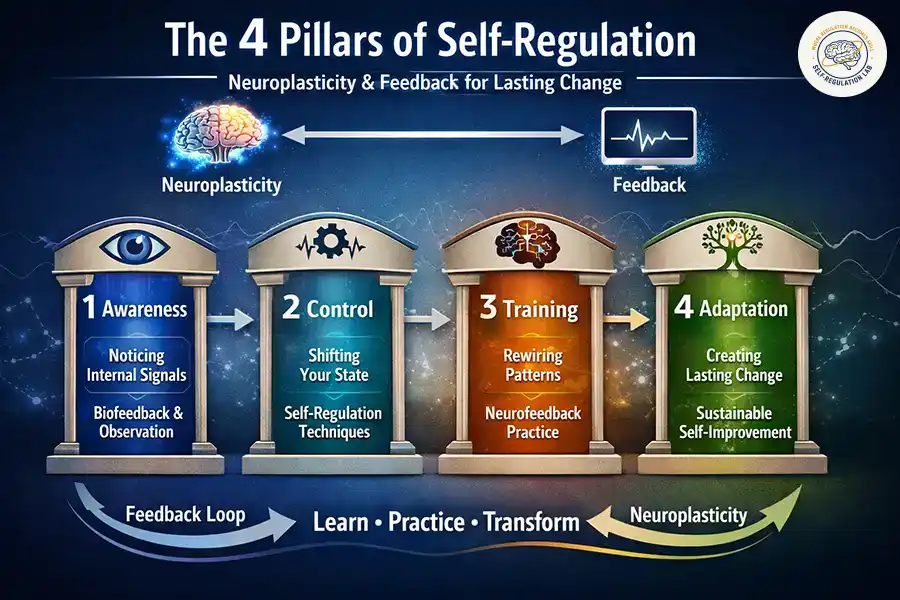
The 4 Pillars of Self-Regulation (Science-Based Framework)
Effective self-regulation is not a single action. It is a trainable process grounded in how the brain and body learn. At its core, this process relies on two fundamental principles:
- Neuroplasticity — the brain’s ability to change and form new patterns
- Feedback — the information that allows you to recognize and adjust those patterns
Without feedback, learning is impossible. And without neuroplasticity, lasting change would not occur.
At the Self-Regulation Lab, these principles are applied through four essential pillars. Together, they create a structured path for developing self-awareness, applying self-regulation techniques, and achieving long-term self-improvement.
Awareness — Recognizing Your Internal Signals
Everything begins with awareness.
To change a pattern, you first need to see it. This includes noticing thoughts, emotional shifts, physical sensations, and early signs of stress. Without self-awareness, your system continues to operate automatically.
Awareness is, in fact, your first level of feedback. It can be developed through simple observation—tracking symptoms, identifying triggers, or noticing where tension appears in the body. However, tools like biofeedback and neurofeedback can significantly enhance this process by making invisible signals visible in real time.
Control — Learning to Influence Your State
Once you become aware of your internal state, the next step is learning how to influence it. Control is not about suppression. Instead, it is about using targeted self-regulation techniques to shift your physiological and emotional responses. Breathing, physical methods, and guided exercises all work by interacting with your nervous system.
At this stage, feedback becomes essential. By observing how your body responds—either subjectively or through biofeedback—you begin to understand what works. This creates a feedback loop: you act, you observe, and you adjust.
Training — Rewiring Through Neuroplasticity
Self-regulation improves through repetition. Every time you recognize a pattern and respond differently, you are engaging neuroplasticity—the brain’s ability to reorganize and form new connections. Over time, these new responses become stronger and more automatic.
However, effective training requires consistent feedback.
This is where structured approaches such as biofeedback and neurofeedback play a key role. They provide real-time information about your brain and body, allowing you to train more precisely and accelerate learning.
Instead of guessing, you begin to train with clarity and direction.
Adaptation — Creating Lasting Change
With consistent practice, your system begins to change.
New patterns become more stable. Stress responses become more balanced. Recovery becomes faster. Symptoms decrease in intensity and frequency.
This is the result of neuroplastic adaptation—when the changes you train are no longer temporary but integrated into how your brain and body function.
At this stage, self-regulation becomes a natural part of your daily life. It evolves into sustainable self-care and long-term self-improvement.
How the System Works
These four pillars form a continuous learning loop:
- Awareness provides feedback
- Control applies change
- Training reinforces new patterns through neuroplasticity
- Adaptation stabilizes those changes over time
This is why self-regulation is not guesswork. It is a structured, learnable process supported by both internal observation and modern digital health tools.
In the Self-Regulation Lab, you will find tools and methods for each stage—from self-awareness quizzes and symptom trackers to biofeedback training and structured self-help books.
Self-Regulation Techniques
From Theory to Practice
Self-regulation techniques are structured methods that help you recognize, influence, and retrain your internal patterns—mental, emotional, and physiological. Many self-regulation techniques are presented in self-help books, but without a clear structure, they can be difficult to apply.
They are not isolated tools. Instead, they are part of a learning process based on two key elements: awareness, which means understanding what is happening in your system, and feedback, which means observing how your system responds to your actions. Through this process, you begin to identify patterns, test different approaches, and gradually change your responses through neuroplasticity.
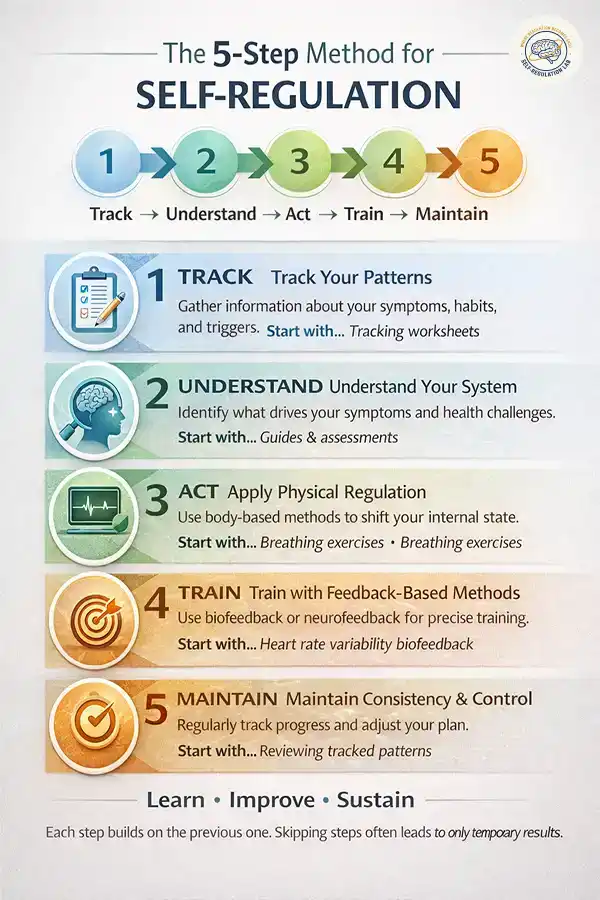
Importantly, not all techniques work in the same way. Some methods help you gather information about yourself. Others directly influence your body. And some support structured learning through digital health tools such as guides, tracking systems, and step-by-step training materials. This is why self-regulation is not about applying random techniques. It is about following a logical sequence: first, you track; then, you understand; then, you act; then, you train; and finally, you maintain.
Below is that sequence, organized into five clear steps. Each step builds on the previous one. Skipping steps often leads to temporary results instead of lasting change.
Step 1: Track Your Patterns
Before you can change anything, you need to know what is happening inside your system.
This first step is about gathering information. It requires no special equipment, only a willingness to observe yourself without judgment.
What to track:
- Start with your lifestyle habits, including diet, sleep quality and duration, hydration, and your daily routine. These create the foundation for everything else.
- Track your symptoms. When do they appear? How long do they last? How intense are they on a scale from one to ten?
- Identify your triggers. What happens just before a symptom appears? This could be a food, a stressful event, a change in weather, a missed meal, or poor sleep.
- Notice your behavioral and cognitive patterns. What do you typically do when stress or symptoms appear? What thoughts run through your mind?
How to track:
Use a simple notebook, a digital document, or our free tracking worksheets. The format matters less than consistency. Track daily for at least one to two weeks.
What this step builds:
This process creates self-awareness. You begin to see yourself as a system with predictable patterns rather than a victim of random suffering.
Step 2: Understand Your System
Once you have tracked your patterns for a week or two, you need to make sense of the data you have collected. This is where digital health tools go beyond traditional self-help approaches by providing structured guidance. You move from raw observation to interpretation.
What this step includes:
Use quizzes and self-assessments to help identify what type of headache or health condition you are dealing with. Compare your tracked symptoms to known patterns for different conditions. For example, if your tracking reveals that your headaches are one-sided, throbbing, and triggered by lights or certain foods, you may be dealing with a neurological circuit issue such as migraine. If your headaches are triggered by jaw clenching, you may be looking at a structural circuit issue, such as tension or TMJ.
What this step builds:
You gain clarity. Instead of guessing, you begin to understand the root mechanism behind your suffering. This understanding allows you to choose the right technique rather than trying random solutions.
Where to start:
In the Digital Health section of the Self-Regulation Lab, you will find resources on how and where to start based on your health condition. These resources are organized to guide you step by step. For example, if you suffer from headaches, our book Stop Guessing, Start Healing was created specifically for this step. It guides you through a diagnostic process to determine whether your pain originates from the neurological, structural, or systemic circuit. Once you know your root cause, you can then choose the specialized guide that matches your specific condition.
Our Digital Health sources are dynamically updated with new conditions, so keep your eye on this section to find the resources that will meet your needs as we expand into anxiety, depression, brain fog, concentration problems, and other challenges.
Step 3: Apply Physical Regulation Methods
Once you understand your system, you are ready to act. Physical regulation methods work directly through your body to influence your internal state. They are often the fastest way to shift how you feel because they act on your nervous system directly.
Dietary approaches:
Certain foods and eating patterns can stabilize blood sugar, reduce inflammation, or avoid known triggers. What works depends on your specific condition, which is why Step 2 understanding is essential before this step.
Supplement support:
Specific nutrients may support nervous system function, reduce inflammation, or address deficiencies. Always consult a professional before starting new supplements.
Sleep hygiene:
Improving sleep quality and consistency is one of the most powerful regulatory tools available. The nervous system repairs itself during deep sleep.
Lifestyle and daily rhythm:
A predictable daily schedule reduces nervous system load. Regular meal times, consistent wake and sleep times, and built-in recovery periods all matter.
Breathing techniques:
Diaphragmatic breathing and other controlled breathing methods activate the parasympathetic nervous system, shifting you out of survival mode.
Cold exposure:
Brief exposure to cold water or air builds stress resilience over time and reduces inflammation.
Heat application:
Sauna use, warm baths, or heating pads relax muscles, lower cortisol, and improve circulation.
Physical activity:
Movement releases tension, regulates mood, improves sleep, and builds overall resilience. The type and intensity should match your current capacity.
How to use this step:
Do not try all of these at once. Choose one method from this list based on the patterns you revealed in Steps 1 and 2. Practice it daily for one to two weeks. Track, observe, and write notes about what changes using our worksheets or your own tracking method. Then add another method or adjust your approach based on what you learn.
Step 4: Train with Feedback-Based Methods
This is where self-regulation becomes more precise and structured. As discussed earlier, learning depends on feedback. Without feedback, you rely only on subjective perception. With feedback, you gain measurable insight into how your body and brain function in real time.
Both biofeedback and neurofeedback work through neuroplasticity. When you receive real-time information about your physiological or brain activity and practice shifting it, your nervous system gradually rewires itself. This is not a temporary change. This is lasting learning at the level of neural pathways.
Choosing the right feedback modality based on your condition.
Not all feedback methods are the same. The choice of biofeedback or neurofeedback should be based on what you discovered in Steps 1, 2, and 3. The table below guides you toward the most appropriate modality for your primary challenge. This table is not a diagnosis. It is a guide based on common clinical applications. If you are unsure, start with HRV biofeedback.
Biofeedback and Neurofeedback Modalities by Health Condition
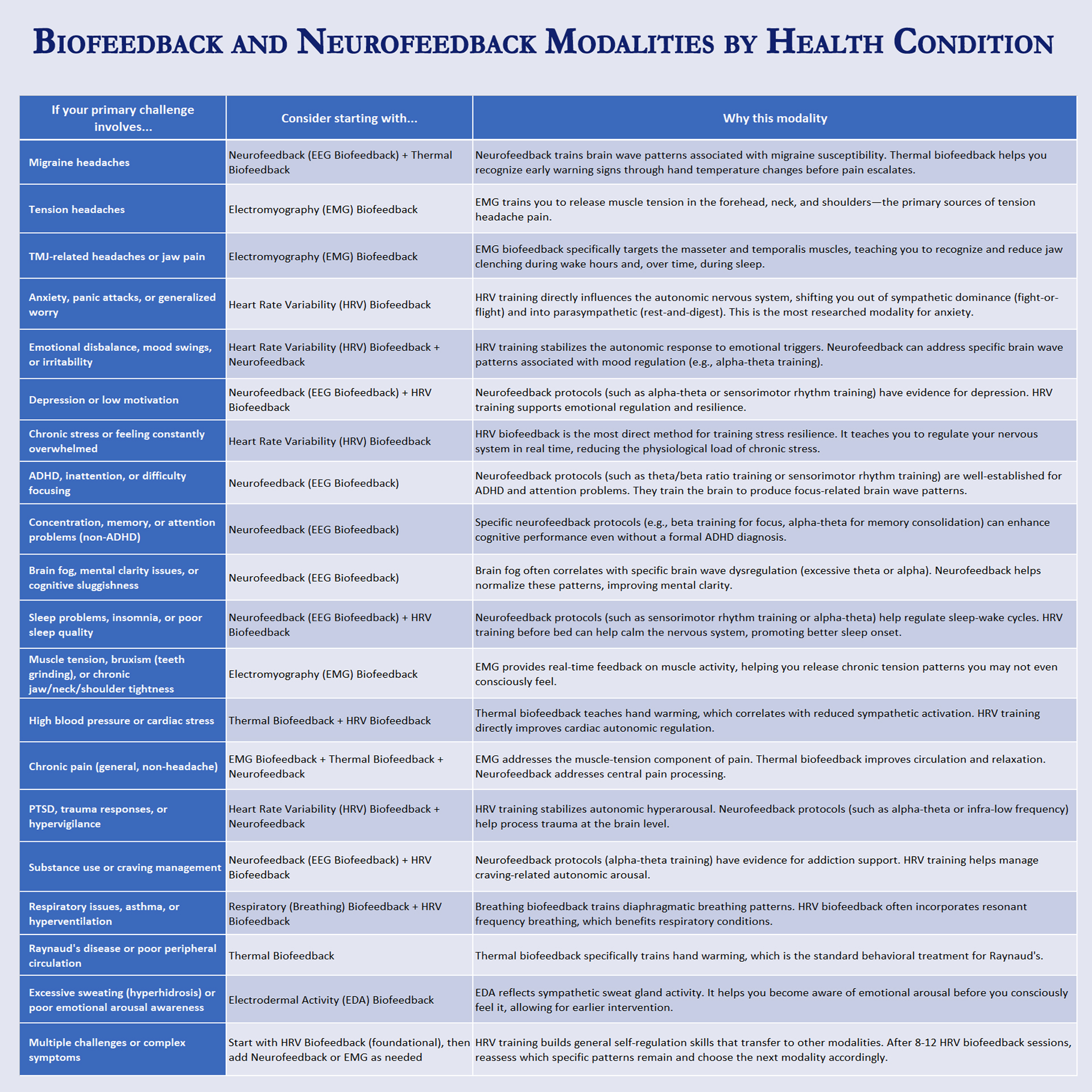
Important note: These modalities are not mutually exclusive. Many people benefit from starting with HRV biofeedback to build foundational self-regulation skills, then adding neurofeedback for specific brain-based challenges. Others begin with EMG for tension and later incorporate neurofeedback for migraines. Your path depends on your unique patterns.
How to use this step:
Choose the biofeedback modality based on your work in Steps 1 through 3. If you are still unsure, start with HRV biofeedback. It is the most general and has the widest applicability across conditions.
Feedback-based training is not only for persistent symptoms. Even if your symptoms are well managed by Steps 1 through 3, adding biofeedback or neurofeedback can accelerate your progress, deepen your self-awareness, and create more durable, long-lasting results through the power of neuroplasticity.
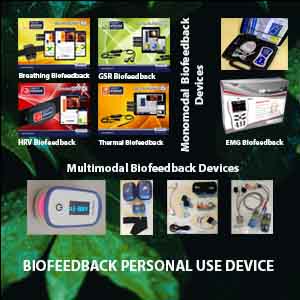
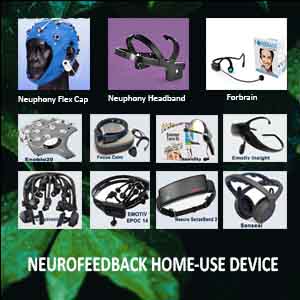
You can train with professional guidance from a practitioner or with home-use devices designed for self-training. Both approaches are valid. What matters most is consistency and correct application.
Step 5: Maintain Consistency and Control
Self-regulation is not a one-time fix. It is an ongoing process of refinement. Once you have established a practice that works for you, the final step is to maintain it while remaining open to adjustment.
What this step includes:
Periodically track your symptoms again, perhaps for one week each month, to catch any changes early. Compare your current patterns to your baseline from Step 1. If symptoms worsen or new patterns emerge, revisit Step 2 to understand what has changed. Adjust your physical methods or training protocols based on what you discover. And celebrate your progress. Even small reductions in symptom frequency or intensity are signs that your system is learning.
What this step builds:
You move from reactive suffering to proactive self-care. Instead of being surprised by symptoms, you notice early warning signs and respond intentionally. Instead of guessing, you have a personalized system that you trust.
This is the foundation for building effective, long-lasting results. The habits you create in Step 5 are what separate temporary relief from permanent change. Over time, this process becomes a powerful system for long-term self-improvement and sustainable self-care. Consistency over time is what allows neuroplasticity to work in your favor. Each small act of self-regulation reinforces the neural pathways that keep your system balanced, making it easier to regulate tomorrow than it was today.
Why the Self-Regulation Lab Was Created
This five-step sequence is exactly why the Self-Regulation Lab was created.
Here, you will find structured digital health resources designed to guide you step by step: to uncover the real mechanisms behind your symptoms, to track and interpret your patterns with clarity, and to apply the most effective techniques in the right sequence for your unique situation.
You may start with Step 1 and move through each step in order. Or you may discover that you have already done some of this work and can begin at a later step. The path is flexible because your journey is unique.
Over time, this becomes a personalized system for self-improvement and sustainable self-care.
Where to Start Today
- If you are new to self-regulation or feel overwhelmed, begin with Step 1. Download our free tracking worksheets and spend one to two weeks simply observing your patterns without trying to change anything.
- If you have already been tracking but do not understand what your patterns mean, move to Step 2. Visit the Digital Health section of this lab to find the resources that match your condition. For headaches, our book Stop Guessing, Start Healing will help you identify your root cause. For other conditions, check back as we add new guides dynamically.
- If you understand your condition but need practical tools, Step 3 offers a menu of physical methods. Choose one based on the patterns you revealed in Steps 1 and 2, and practice it daily.
- If you have done all of the above and want to accelerate your progress or train with precision, Step 4 offers biofeedback and neurofeedback options. Use the table above to choose the modality that best matches your primary challenge.
Self-regulation is a practice, not a destination. Consistency matters more than perfection.
How the Self-Regulation Lab Supports Your Journey
The Self-Regulation Lab was built to provide you with everything you need to move through these five steps with clarity and confidence.
Our resources are organized around a simple principle: first, understand your pattern; then, apply the right technique at the right time.
Free tools for every step: In addition to our books, you will find free tools to support every step. Our tracking worksheets help you complete Step 1 with structure and consistency. The self-assessment quiz helps you move from Step 1 to Step 2 by identifying your dominant pattern. Our infographics explain the science of self-regulation in simple visuals that reinforce your understanding. And our reset worksheet puts the entire five-step sequence into a printable format that you can follow day by day.
Feedback-based training: For those who want to train with precision in Step 4, we provide guides for home use of biofeedback and neurofeedback devices, along with links to professional resources if you prefer working with a practitioner. Use the table in Step 4 to choose the modality that best matches your condition.
Learning resources: And if you simply want to learn more, our growing library of articles covers the science of biofeedback, neurofeedback, and self-regulation across a range of health conditions.
Everything in the lab is designed to work together. You can start with a free tracking worksheet, move to the diagnostic book, apply physical methods, and then train with biofeedback. Keep an eye on our Digital Health section, as we dynamically update it with new resources for different health conditions. As we develop guides for anxiety, depression, brain fog, concentration problems, and other challenges, they will appear here.The
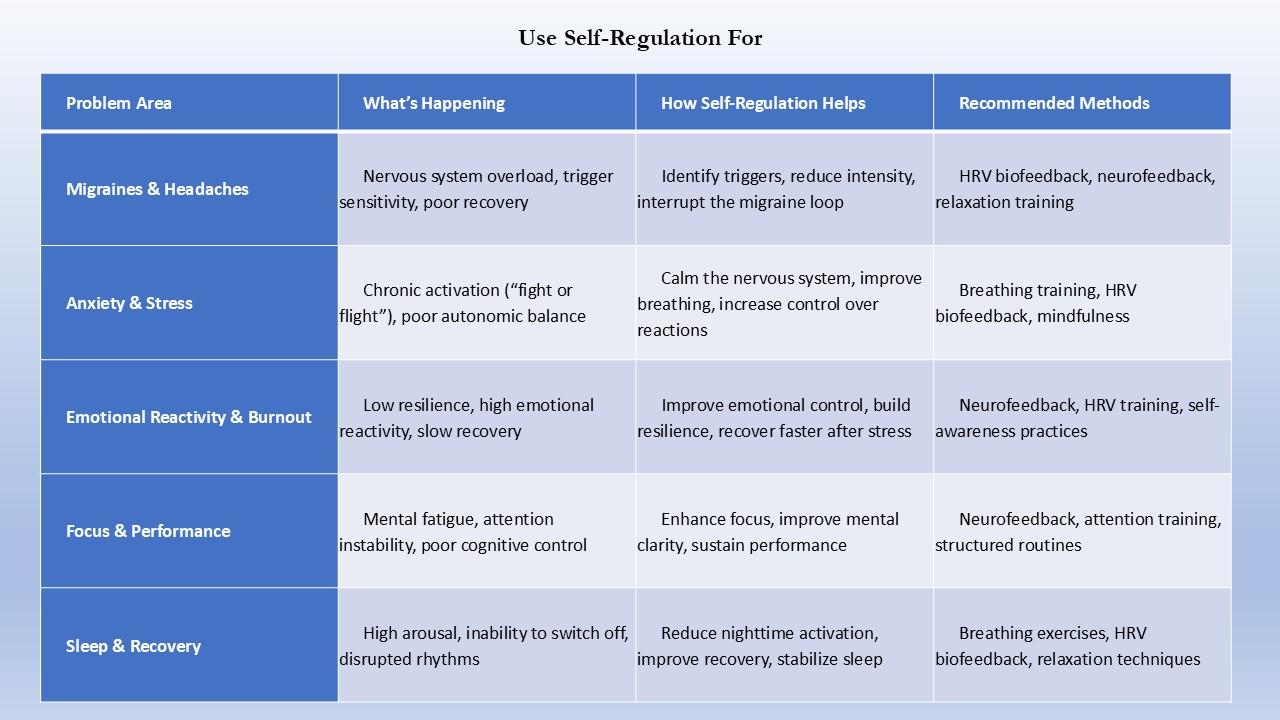
Where Can You Apply Self-Regulation?
Self-regulation is not limited to one problem.
On the contrary, it is a core skill that affects multiple areas of your life. Once you learn how to regulate your system, you can apply it to different challenges.
The same five-step process you just learned applies to almost any health condition. The table below shows how self-regulation can be applied across different challenges. For each condition, the same principles apply: track, understand, act, train, and maintain.
Related Articles

Overwhelmed at Work? Find Balance
Feeling overwhelmed at work can leave you drained, anxious, and...
Read More
Stop Overthinking: Retrain Your Brain
Do you constantly feel trapped in a cycle of racing...
Read More
Stop Bruxism and TMJ Pain Naturally
Are you struggling with persistent jaw pain, teeth grinding, or...
Read More
Fear Therapy: Cure Phobias Fast
Do you feel paralyzed by irrational fears or phobias that...
Read MoreDigital Health Sources
For decades, people relied on a passive model of care. You feel symptoms → you take a pill → you wait. However, this approach does not teach your brain or body how to regulate itself. As a result, the underlying patterns remain unchanged.
Today, this is changing. From Treatment to Training.
Modern digital health solutions are shifting the focus. Instead of suppressing symptoms, they help you train your nervous system. This is the key difference:
- Passive care → temporary relief
- Active training → long-term regulation
As a result, you are no longer dependent on external solutions. Instead, you build internal control.
Click on any book to learn more and purchase. All books are available as interactive PDF, print PDF, Kindle, and ePub.
FAQ
Self-regulation is the ability to monitor and control your thoughts, emotions, and physical responses. It allows you to shift from stress, pain, or reactivity into a more balanced and controlled state.
Without self-regulation, the body can remain stuck in chronic stress patterns, which may lead to anxiety, migraines, fatigue, and emotional instability. With proper training, however, you can restore balance and improve performance, focus, and well-being.
Yes. Self-regulation is a trainable skill, not a fixed trait. With consistent practice and feedback-based methods such as biofeedback or neurofeedback, the brain and body can learn to respond more efficiently over time.
Effective techniques include:
- Breathing and relaxation training
- Heart rate variability (HRV) training
- Biofeedback (muscle, skin response, temperature)
- Neurofeedback (brain training)
- Lifestyle adjustments (sleep, hydration, nutrition)
The best approach depends on your specific symptoms and goals.
Yes. Self-regulation techniques can help identify and modify triggers such as stress, muscle tension, and vascular changes, which are often involved in migraines. Many approaches, including biofeedback, are widely used as non-invasive support tools.
Absolutely. Self-regulation directly targets the nervous system, helping reduce overactivation and improve emotional control. This makes it one of the most effective approaches for managing anxiety and chronic stress.
Not necessarily. You can start with basic techniques like breathing and awareness. However, devices such as biofeedback and neurofeedback tools can accelerate learning by providing real-time feedback.
References
- Crivelli D, Vignati B. Fostering psychophysical well-being via remote self-managed empowerment protocols: a scoping review. Brain Sci. 2025;15(11):1194. doi:10.3390/brainsci15111194 🔗 https://www.mdpi.com/2076-3425/15/11/1194
- Vignati B, Crivelli D. Active role of participants in neuroempowerment training and supportive neurotechnologies: a theoretical methodological perspective. Front Psychol. 2025;16:1660000. doi:10.3389/fpsyg.2025.1660000
🔗 https://www.frontiersin.org/journals/psychology/articles/10.3389/fpsyg.2025.1660000 - Kaiser DA, Othmer S. Effect of neurofeedback on variables of attention in a large multi-center trial. J Neurother. 2000;4(1):5–15. doi:10.1300/J184v04n01_02 🔗 https://www.tandfonline.com/doi/abs/10.1300/J184v04n01_02
- Mirifar A, Keil A, Ehrlenspiel F. Neurofeedback and neural self-regulation: a new perspective based on allostasis. Rev Neurosci. 2022 Feb 7;33(6):607-629. doi: 10.1515/revneuro-2021-0133. PMID: 35122709; PMCID: PMC9381001. – 🔗https://pmc.ncbi.nlm.nih.gov/articles/PMC9381001/
- Marzbani H, Marateb HR, Mansourian M. Neurofeedback: A comprehensive review on system design, methodology, and clinical applications. Basic Clin Neurosci. 2016;7(2):143–158. Available from: 🔗 https://www.ncbi.nlm.nih.gov/pmc/articles/PMC4892319/
- Thibault RT, Lifshitz M, Raz A. The self-regulating brain and neurofeedback: experimental science and clinical promise. Cortex. 2016;74:247-261. doi:10.1016/j.cortex.2015.10.024 🔗 https://www.sciencedirect.com/science/article/abs/pii/S0010945215003767
- Reed RG, Combs HL, Segerstrom SC. The Structure of Self-Regulation and Its Psychological and Physical Health Correlates in Older Adults. Collabra Psychol. 2020;6(1):23. doi: 10.1525/collabra.297. Epub 2020 Apr 15. PMID: 32457933; PMCID: PMC7250393. – 🔗 https://pmc.ncbi.nlm.nih.gov/articles/PMC7250393/
- Jafarova, O., Mazhirina, K., Sokhadze, E. et al. Self-regulation Strategies and Heart Rate Biofeedback Training. Appl Psychophysiol Biofeedback 45, 87–98 (2020). 🔗 https://doi.org/10.1007/s10484-020-09460-5 –
- Taub, E., Emurian, C.S. Feedback-aided self-regulation of skin temperature with a single feedback locus. Biofeedback and Self-Regulation 1, 147–168 (1976). 🔗 https://doi.org/10.1007/BF00998583
- Markiewicz, Renata, Dobrowolska, Beata, Initial Results of Tests Using GSR Biofeedback as a New Neurorehabilitation Technology Complementing Pharmacological Treatment of Patients with Schizophrenia, BioMed Research International, 2021, 5552937, 12 pages, 2021. 🔗 https://doi.org/10.1155/2021/5552937
- Goldberg J, Weller L, Blittner M. Cognitive self-control factors in EMG biofeedback. Biofeedback Self Regul. 1982 Dec;7(4):545-51. doi: 10.1007/BF00998893. PMID: 7165785. – 🔗 https://pubmed.ncbi.nlm.nih.gov/7165785/