Cognition Enhancement: BrainBit Guide
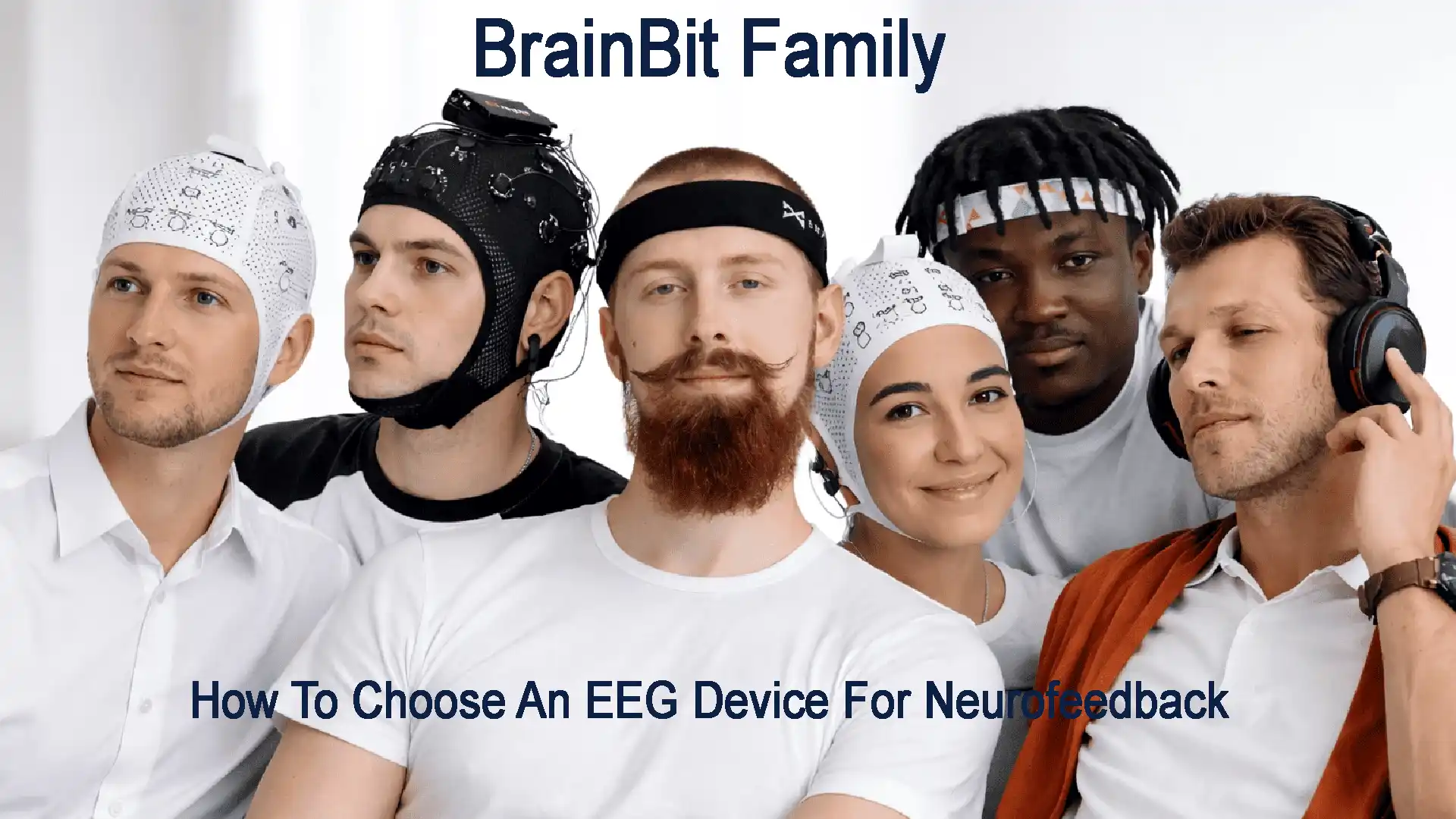
If you are looking for cognition enhancement – whether to improve focus, reduce stress, or boost memory – you have likely come across the term neurofeedback brain training. This science-backed approach uses real-time brainwave monitoring to help you train your brain like a muscle. And for home use, the BrainBit family of EEG headbands stands out as one of the most trusted solutions available. From the soft and comfortable BrainBit MINDO to the professional-grade Dragon EEG for QEEG brain mapping, BrainBit offers a full range of neurofeedback devices for home use. Whether you are new to brain training or an experienced practitioner, there is a BrainBit neurofeedback headband designed for your needs. But here is the challenge: different devices train different brain regions. Choose the wrong one, and you may not see the results you want. Choose the right one, and you unlock your full cognitive potential.
This guide will help you choose the right BrainBit EEG headband for your unique goals – whether you are seeking emotional brain training for anxiety relief, concentration enhancement for work, or peak performance for sports and creativity.
Table of Contents
ToggleCognition Enhancement: The Rule You Should Know Before You Choose
Do you ever feel like your brain is working against you?
You sit down to focus, but your mind wanders. Or you try to remember something important, but the information slips away. You feel stressed, overwhelmed, or mentally exhausted – and you are not sure why. You are not alone. Millions of people experience these challenges every day. But here is the truth:
Your brain is not broken. It just needs the right training.
Just as you would go to a gym and choose different exercises for different muscles, neurofeedback allows you to train specific brain functions by targeting specific brain regions.
But here is the rule you must understand before you choose any device:
To train a specific brain function, you need electrodes positioned over the specific brain region responsible for that function.
This sounds simple. Yet most people overlook it. They buy a device based on price or marketing, only to discover later that it cannot train the brain region they actually need to train.
The Problem You May Face.
If you choose a device without understanding electrode coverage, you may:
- Spend money on a device that cannot train the brain region you need
- Become frustrated when you do not see results
- Leave negative reviews saying “it doesn’t work”
We want to prevent that.
That is why the BrainBit family offers multiple devices – not because one is “better” than another, but because different goals require different electrode coverage.
Brain Regions and Functions Towards Cognition Enhancement
Frontal Lobes (Fp1, Fp2, F3, F4, Fz)
Located at the front of your head, behind your forehead
This region is your brain’s “command center.” It helps you:
- Make decisions and solve problems
- Control impulses and regulate emotions
- Stay motivated and plan ahead
- Focus your attention on what matters
If you struggle with procrastination, emotional outbursts, poor decision-making, or lack of motivation, your frontal lobes may need training.
Central Region (C3, C4, Cz)
Located at the top of your head, running from ear to ear
This region is your brain’s “focus hub.” It helps you:
- Stay calmly alert and attentive (this is called “SMR” – Sensorimotor Rhythm, a brainwave pattern associated with relaxed focus)
- Process sensory information quickly (for example, reacting to a fast-moving ball or a sudden sound)
- Maintain consistent performance without mental fatigue
If you struggle with distractibility, inconsistent focus, slow reactions, or mental exhaustion during tasks, your central region may need training.
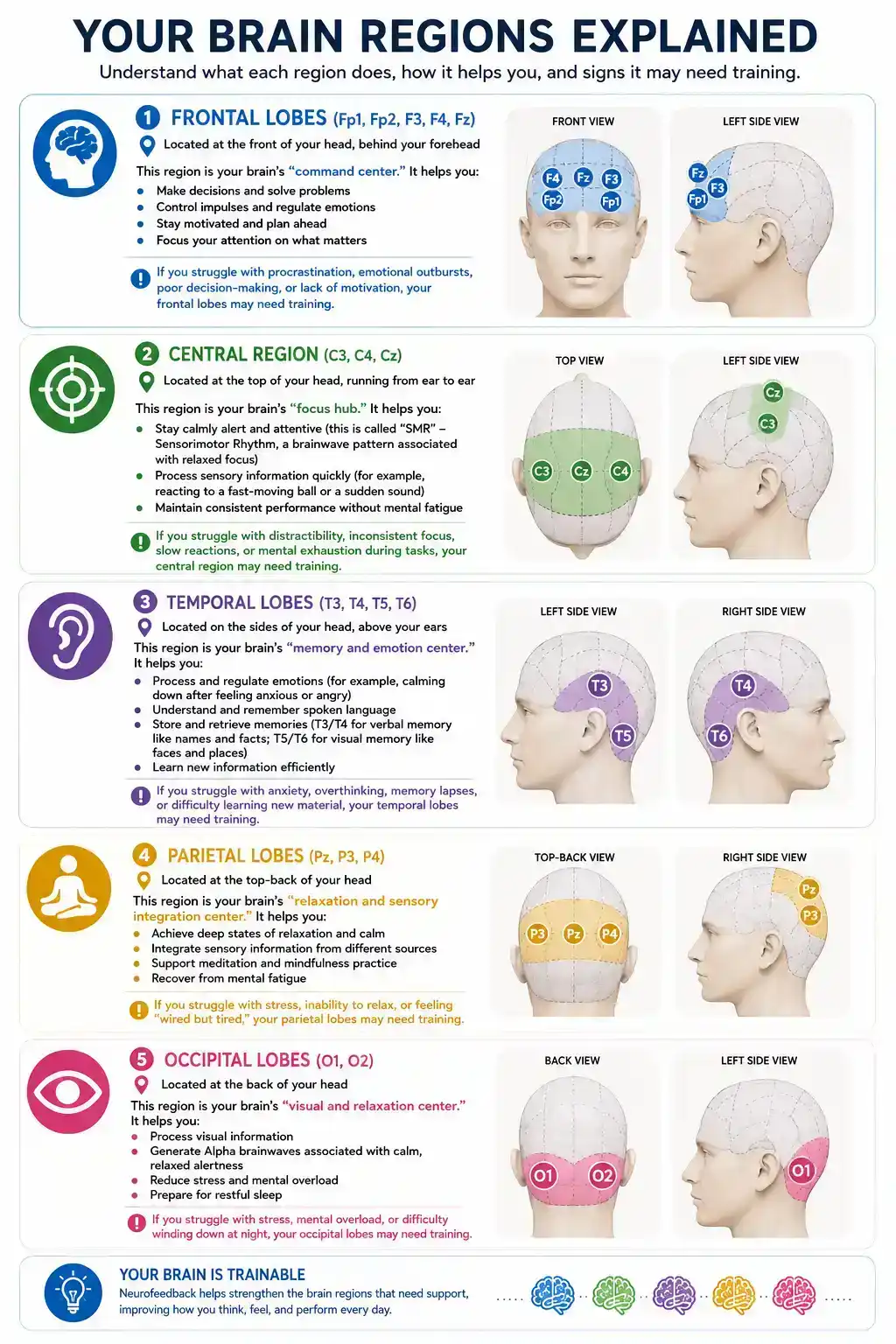
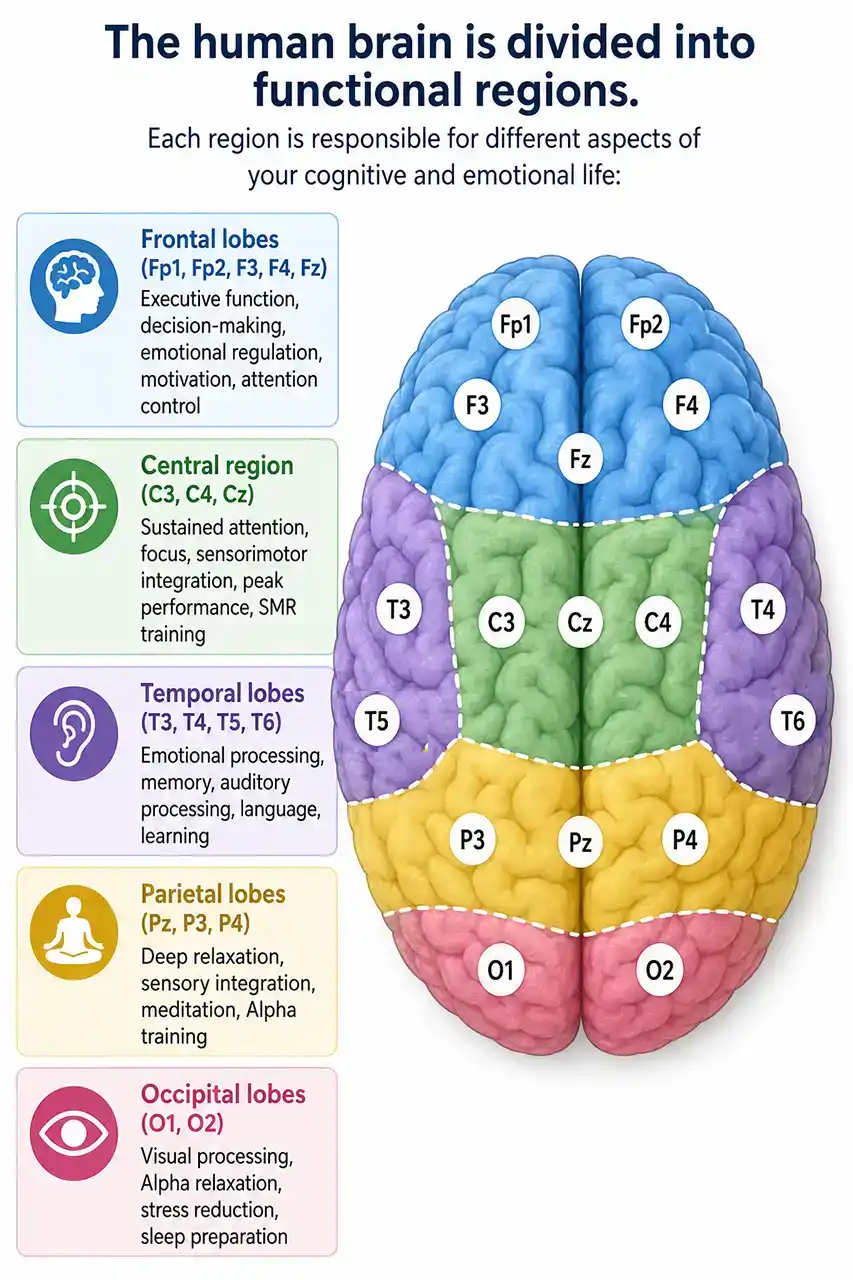
Temporal Lobes (T3, T4, T5, T6)
Located on the sides of your head, above your ears
This region is your brain’s “memory and emotion center.” It helps you:
- Process and regulate emotions (for example, calming down after feeling anxious or angry)
- Understand and remember spoken language
- Store and retrieve memories (T3/T4 for verbal memory like names and facts; T5/T6 for visual memory like faces and places)
- Learn new information efficiently
If you struggle with anxiety, overthinking, memory lapses, or difficulty learning new material, your temporal lobes may need training.
Parietal Lobes (Pz, P3, P4)
Located at the top-back of your head
This region is your brain’s “relaxation and sensory integration center.” It helps you:
- Achieve deep states of relaxation and calm
- Integrate sensory information from different sources
- Support meditation and mindfulness practice
- Recover from mental fatigue
If you struggle with stress, inability to relax, or feeling “wired but tired,” your parietal lobes may need training.
Occipital Lobes (O1, O2)
Located at the back of your head
This region is your brain’s “visual and relaxation center.” It helps you:
- Process visual information
- Generate Alpha brainwaves associated with calm, relaxed alertness
- Reduce stress and mental overload
- Prepare for restful sleep
If you struggle with stress, mental overload, or difficulty winding down at night, your occipital lobes may need training.
Why This Matters for Your Choice:
Now you understand that different brain functions reside in different brain regions.
Some neurofeedback devices can access only a few of these regions. Others can access many – or even all of them.
This guide will help you understand:
- Which brain regions each BrainBit device can access
- Which cognitive functions and mental wellness challenges each device can support. How to use them for cognition enhancement.
- Which device is the right match for YOUR specific needs
Brain Region Coverage: What Each BrainBit Device Can Access
Now that you understand which brain regions control which functions, the next question is:
Which BrainBit device can access the brain regions YOU need to train?
This is the most important section of this guide. Take your time to understand it.
The table below shows:
✅ = This device CAN access this brain region
❌ = This device CANNOT access this brain region
Remember: If a device cannot access a brain region, it cannot train the functions that live in that region.
BrainBit Family Brain Region Coverage
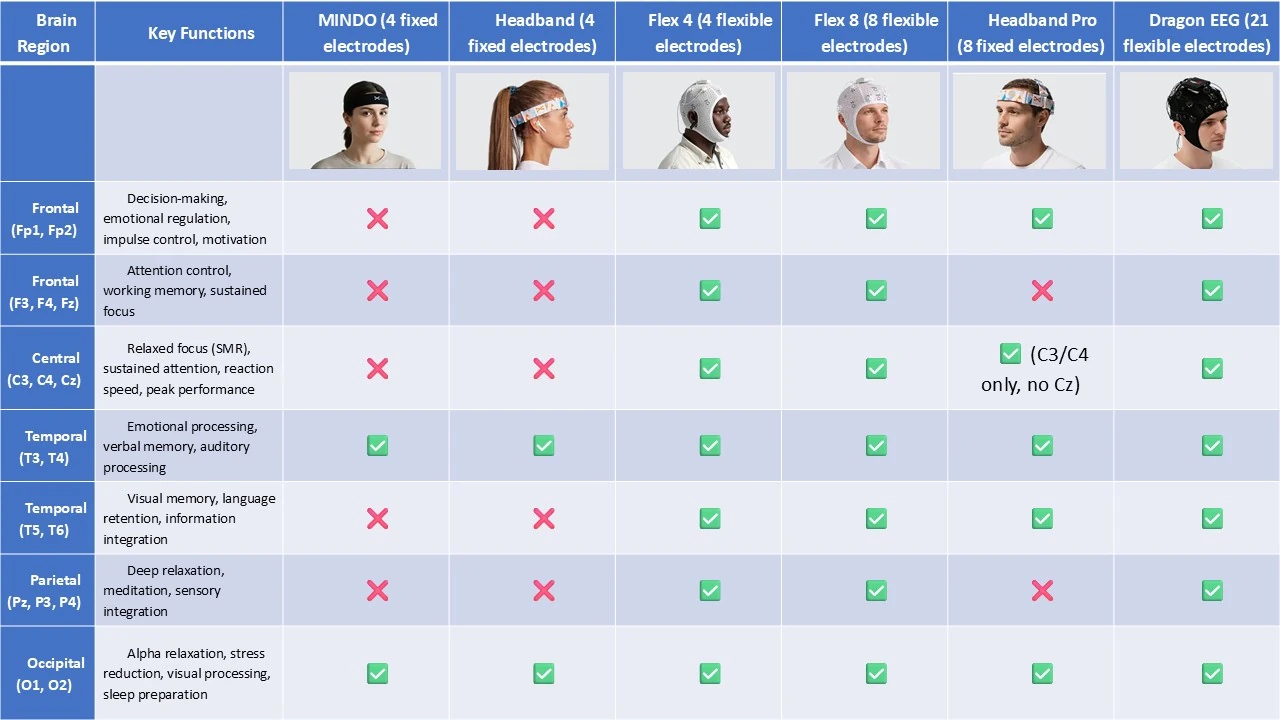
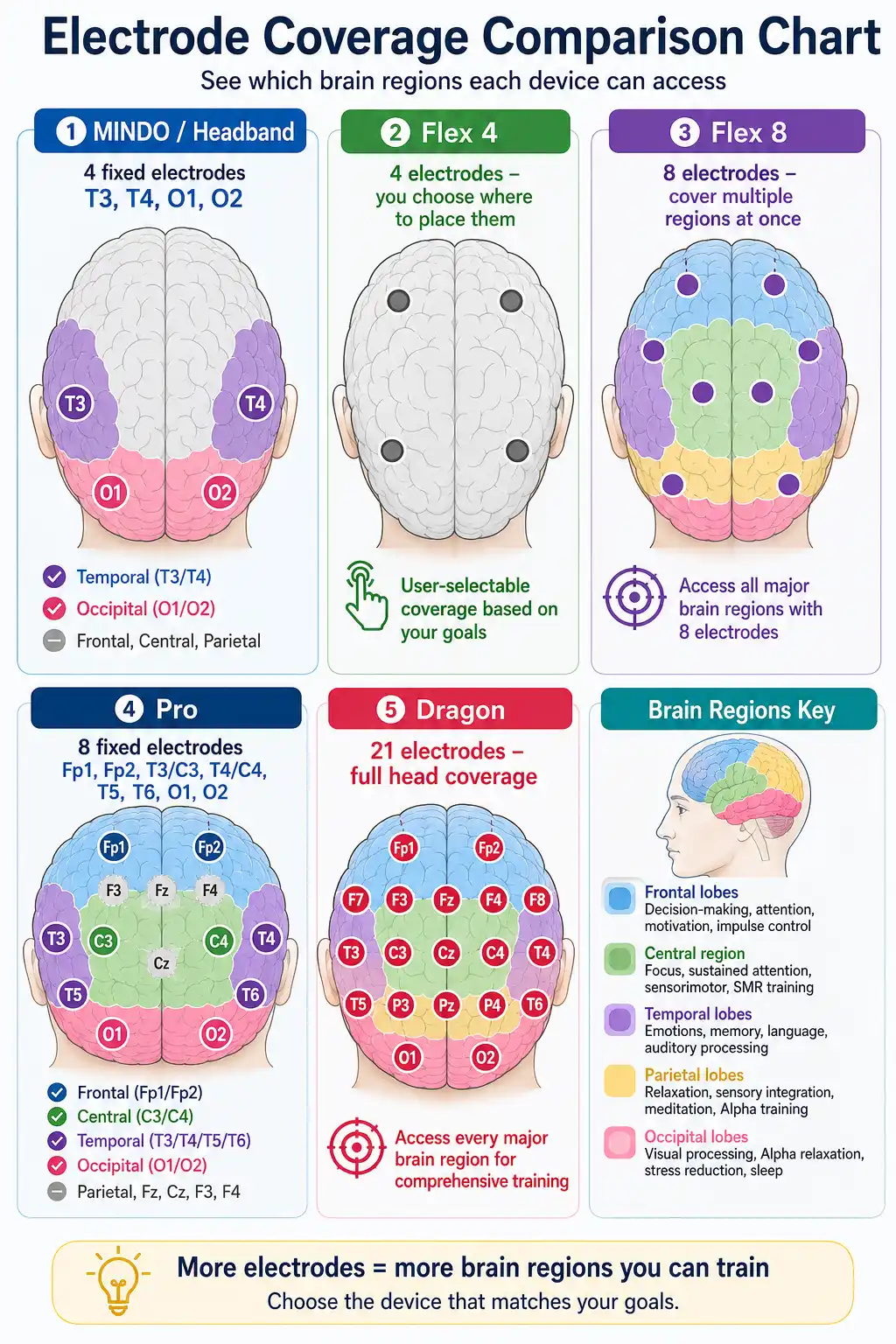
What This Table Reveals
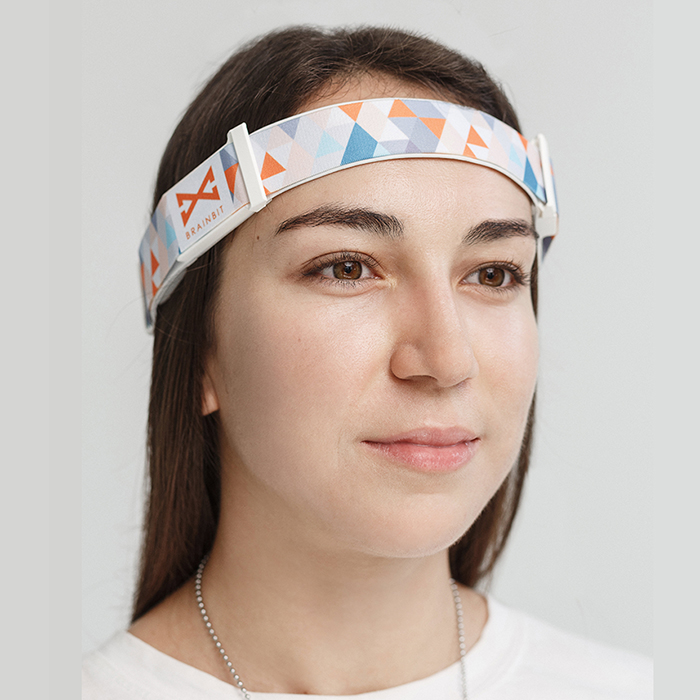
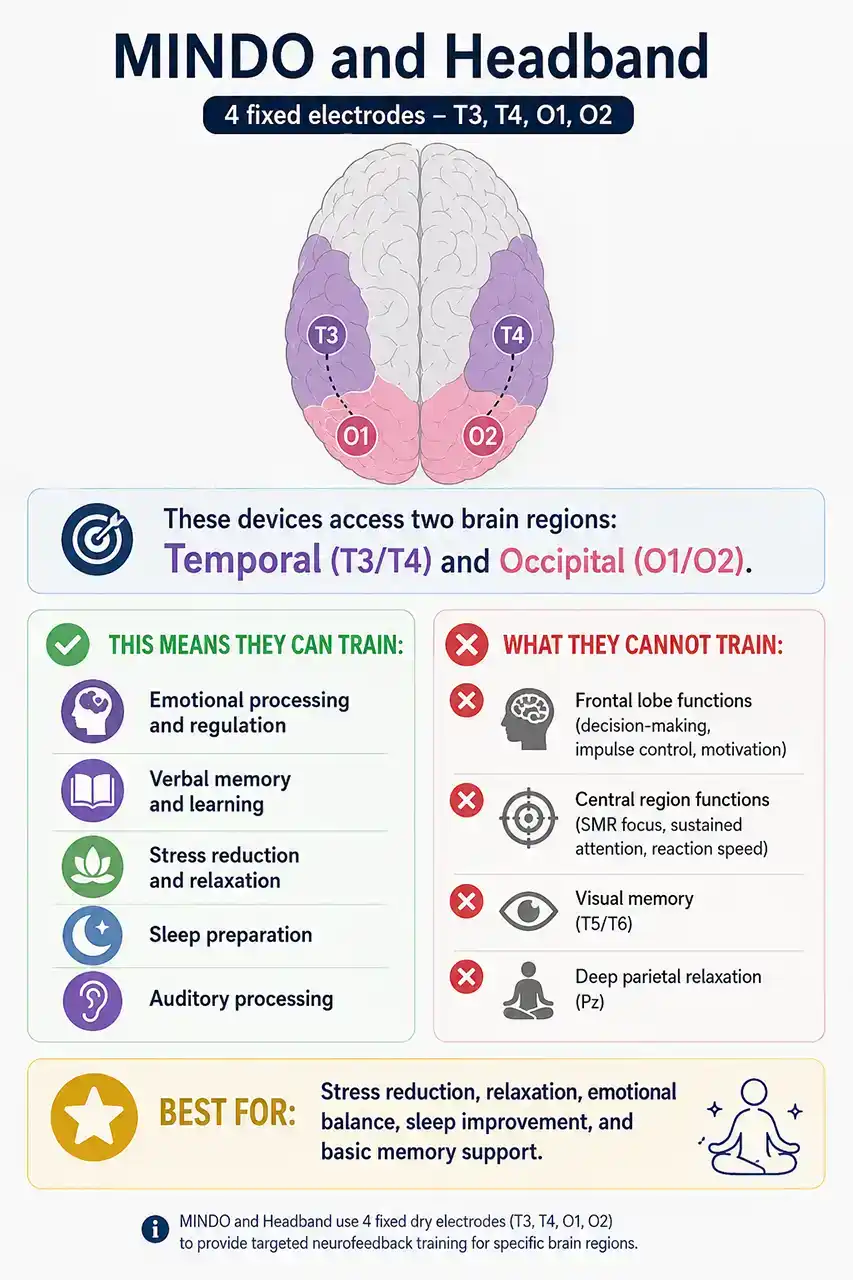
MINDO and Headband (4 fixed electrodes – T3, T4, O1, O2)
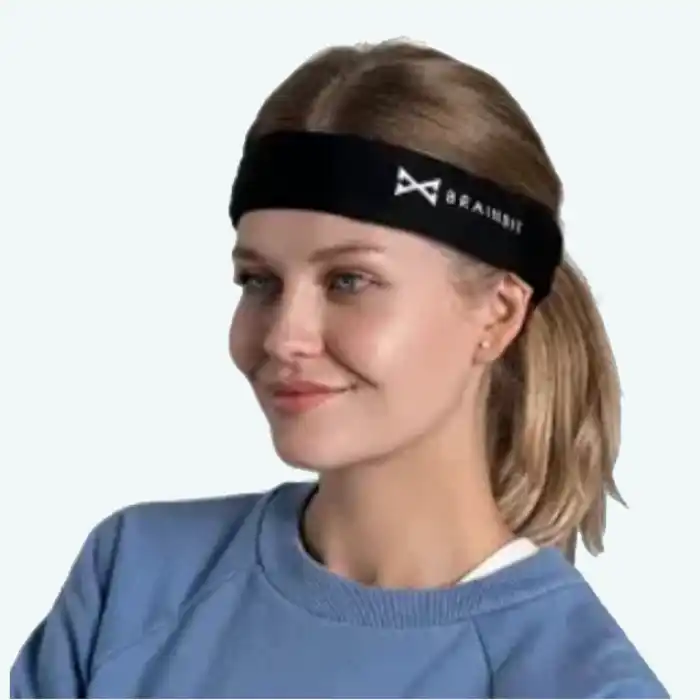
These devices access two brain regions: Temporal (T3/T4) and Occipital (O1/O2).
This means they can train:
- Emotional processing and regulation
- Verbal memory and learning
- Stress reduction and relaxation
- Sleep preparation
- Auditory processing
What they cannot train:
- Frontal lobe functions (decision-making, impulse control, motivation)
- Central region functions (SMR focus, sustained attention, reaction speed)
- Visual memory (T5/T6)
- Deep parietal relaxation (Pz)
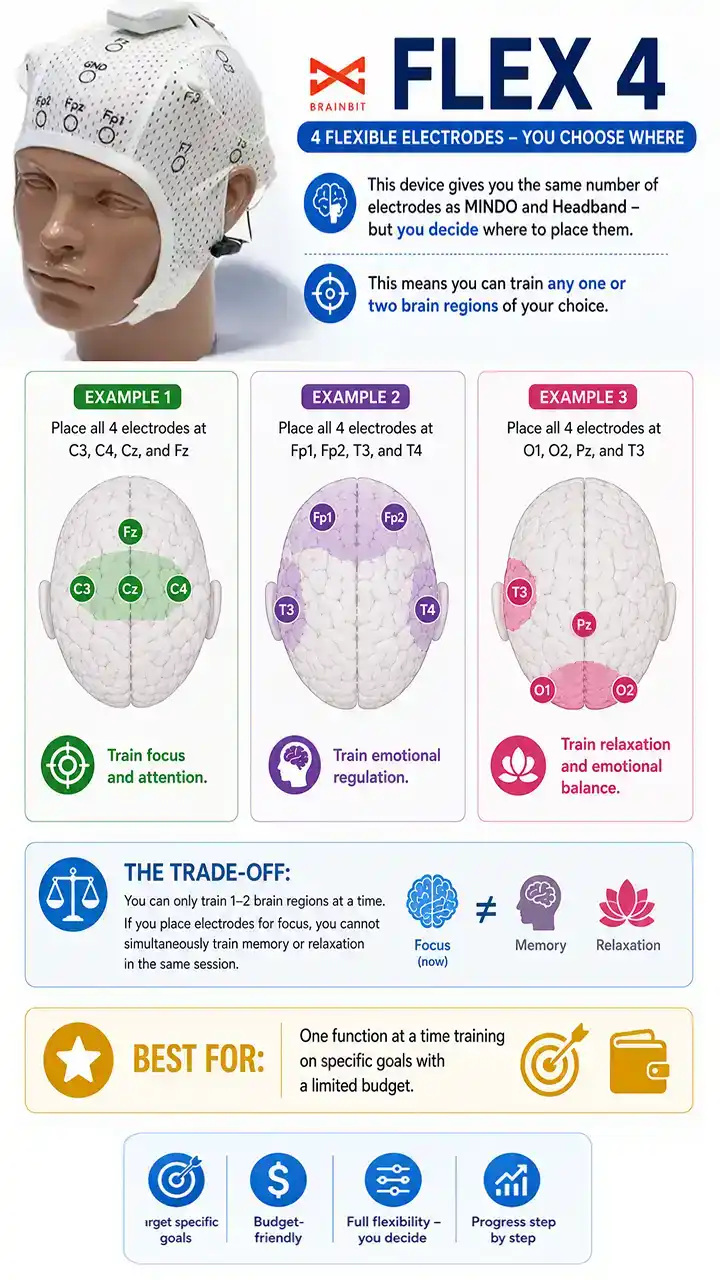
Flex 4 (4 flexible electrodes – YOU choose where)
This device gives you the same number of electrodes as MINDO and Headband – but you decide where to place them.
This means you can train any one or two brain regions of your choice.
Example 1:
Place all 4 electrodes at C3, C4, Cz, and Fz to train focus and attention.
Example 2:
Place all 4 electrodes at Fp1, Fp2, T3, and T4 to train emotional regulation.
Example 3:
Place all 4 electrodes at O1, O2, Pz, and T3 to train relaxation and emotional balance.
The trade-off: You can only train 1-2 brain regions at a time. If you place electrodes for focus, you cannot simultaneously train memory or relaxation in the same session.
What This Means for You:
Flex 4 is the ideal choice if you have a limited budget but still want the power to target specific brain functions with precision. Because you choose exactly where to place the electrodes, you can achieve full coverage for a single goal – whether that is improving focus (C3, C4, Cz, Fz), regulating emotions (Fp1, Fp2, T3, T4), or enhancing relaxation (O1, O2, Pz, T3).
However, with only 4 electrodes, you must prioritize one function per session. You cannot train focus and memory simultaneously in the same session. This makes Flex 4 perfect for users who know exactly what they want to train and are comfortable focusing on one goal at a time.
Best for: Stress reduction, relaxation, emotional balance, sleep improvement, and basic memory support. One function at a time training on specific goals with a limited budget.
Flex 8 (8 flexible electrodes – YOU choose where)
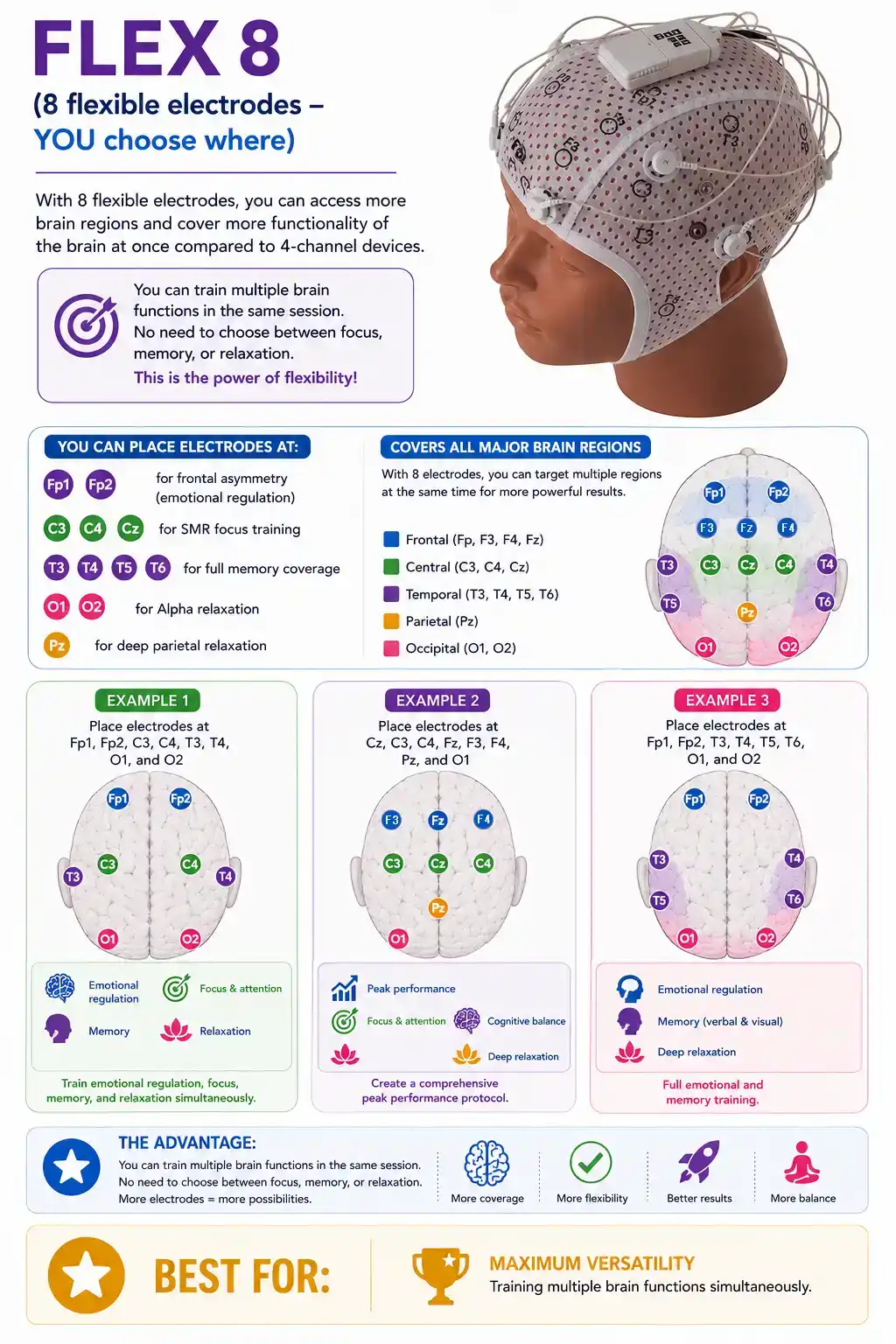
With 8 flexible electrodes, you can access more brain regions and cover more functionality of the brain at once compared to 4-channel devices.
You can place electrodes at:
- Fp1 and Fp2 for frontal asymmetry (emotional regulation)
- C3, C4, and Cz for SMR focus training
- T3, T4, T5, and T6 for full memory coverage
- O1 and O2 for Alpha relaxation
- Pz for deep parietal relaxation
Example 1:
Place electrodes at Fp1, Fp2, C3, C4, T3, T4, O1, and O2 to train emotional regulation, focus, memory, and relaxation simultaneously.
Example 2:
Place electrodes at Cz, C3, C4, Fz, F3, F4, Pz, and O1 to create a comprehensive peak performance protocol.
Example 3:
Place electrodes at Fp1, Fp2, T3, T4, T5, T6, O1, and O2 for full emotional and memory training.
The advantage: With Flex 8, you can train multiple brain functions in the same session. No need to choose between focus, memory, or relaxation.
Best for: Maximum versatility. Training multiple brain functions simultaneously.
What This Means for You:
Flex 8 is the most versatile device in the BrainBit family. With 8 flexible electrodes, you can access all major brain regions simultaneously, allowing you to train multiple cognitive functions in a single session.
Unlike Flex 4, which requires you to choose one function at a time, Flex 8 lets you combine protocols – for example, training focus (Cz/C3/C4) and emotional regulation (Fp1/Fp2) and relaxation (O1/O2) all at once. This makes it ideal for users with complex goals who want comprehensive, multi-functional training without trade-offs.
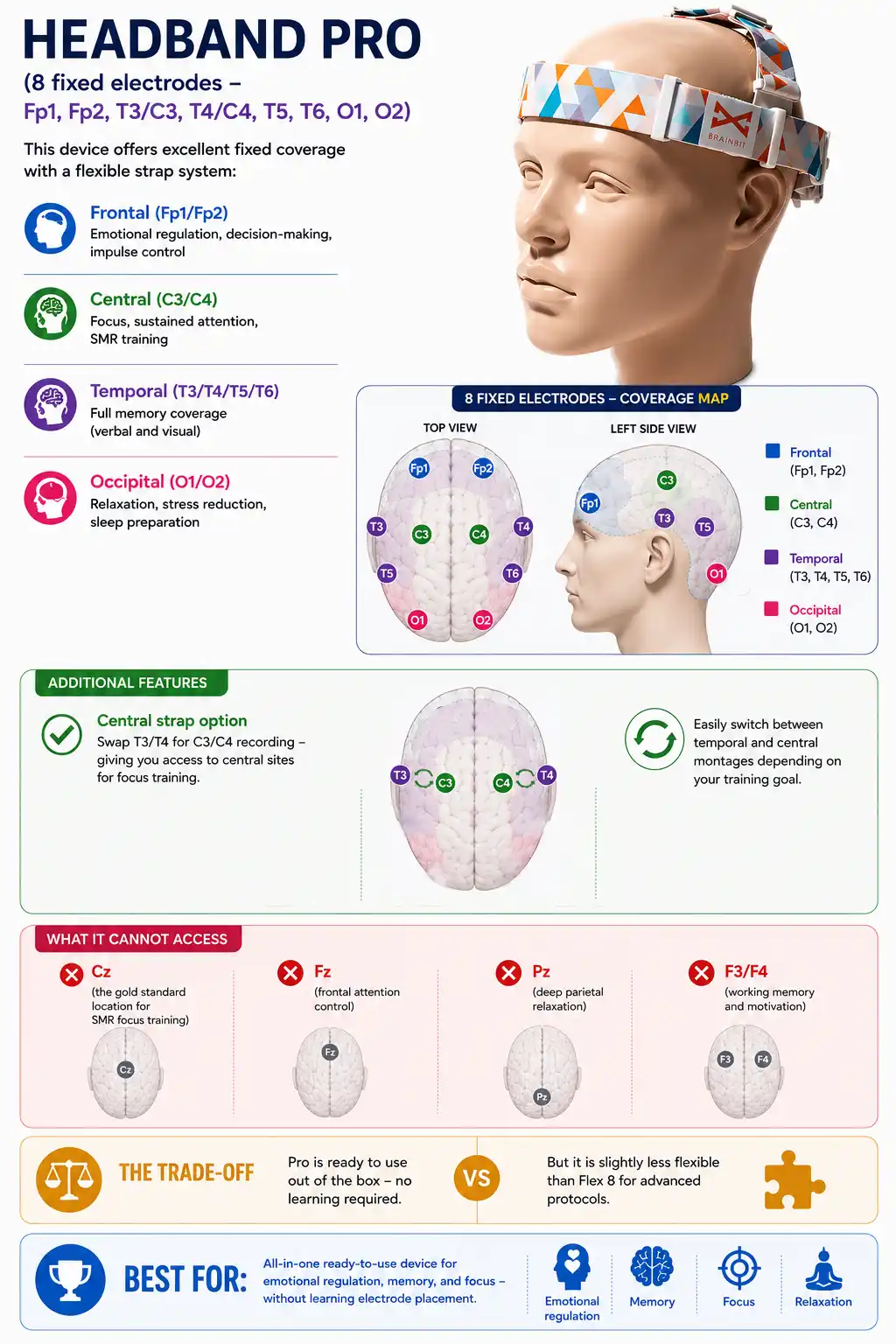
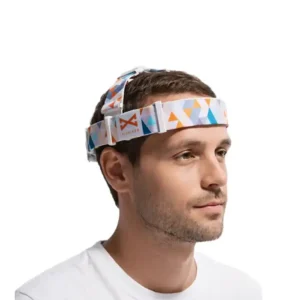
Headband Pro (8 fixed electrodes – Fp1, Fp2, T3/C3, T4/C4, T5, T6, O1, O2)
This device offers excellent fixed coverage with a flexible strap system:
- Frontal (Fp1/Fp2) – Emotional regulation, decision-making, impulse control
- Central (C3/C4) – Focus, sustained attention, SMR training
- Temporal (T3/T4/T5/T6) – Full memory coverage (verbal and visual)
- Occipital (O1/O2) – Relaxation, stress reduction, sleep preparation
Additional features:
- Central strap option: Swap T3/T4 for C3/C4 recording – giving you access to central sites for focus training
- Quick reconfiguration: Easily switch between forehead, temporal, occipital, or central montages depending on your training goal
What it cannot access:
- Cz (the gold standard location for SMR focus training)
- Fz (frontal attention control)
- Pz (deep parietal relaxation)
- F3/F4 (working memory and motivation)
The trade-off: Headband Pro is ready to use out of the box – no learning required. But it is slightly less flexible than Flex 8 in terms of advanced protocols.
What This Means for You:
Headband Pro is the ultimate all-in-one, ready-to-use device. It comes with fixed electrodes covering the most important brain regions for emotional regulation (Fp1/Fp2), focus (C3/C4), memory (T3–T6), and relaxation (O1/O2). You simply put it on and start training – no need to learn electrode placement.
The central strap option adds flexibility, allowing you to swap temporal for central recording. This makes Pro an excellent choice for users who want comprehensive coverage without the complexity of a fully customizable system.
However, if you need access to Cz (the gold standard for SMR focus training), Fz (attention control), or Pz (deep relaxation), Flex 8 offers greater flexibility. For most users, Pro’s fixed coverage provides everything needed for daily cognitive training.
Best for: All-in-one ready-to-use device for emotional regulation, memory, and focus – without learning electrode placement.
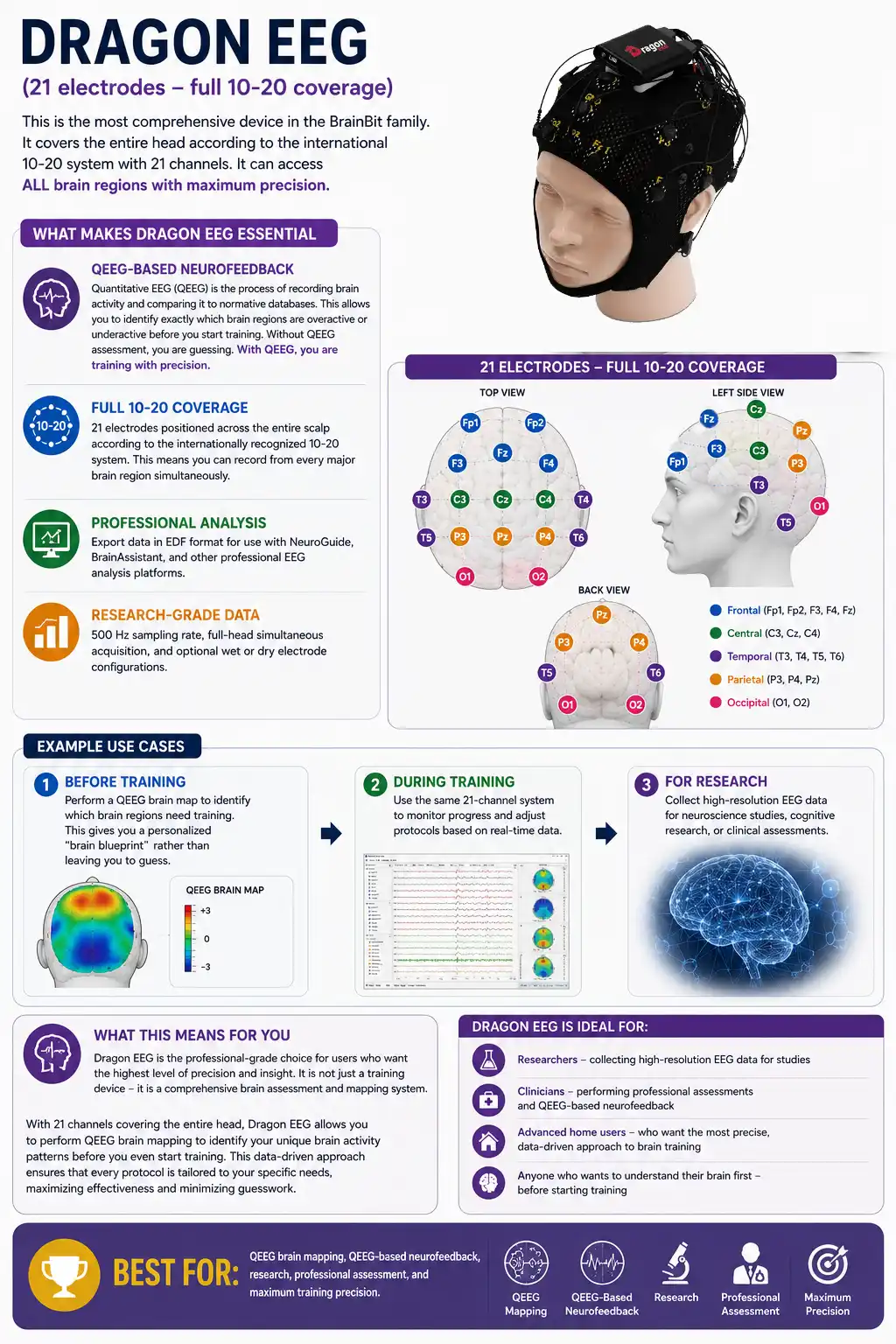
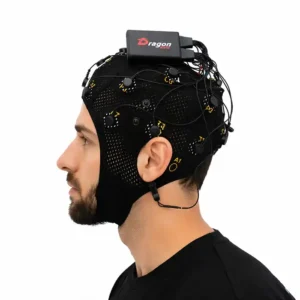
Dragon EEG (21 electrodes – full 10-20 coverage)
This is the most comprehensive device in the BrainBit family. It covers the entire head according to the international 10-20 system with 21 channels. It can access ALL brain regions with maximum precision.
What makes Dragon EEG essential:
- QEEG-based neurofeedback – Quantitative EEG (QEEG) is the process of recording brain activity and comparing it to normative databases. This allows you to identify exactly which brain regions are overactive or underactive before you start training. Without QEEG assessment, you are guessing. With QEEG, you are training with precision.
- Full 10-20 coverage – 21 electrodes positioned across the entire scalp according to the internationally recognized 10-20 system. This means you can record from every major brain region simultaneously.
- Professional analysis – Export data in EDF format for use with NeuroGuide, BrainAssistant, and other professional EEG analysis platforms.
- Research-grade data – 500 Hz sampling rate, full-head simultaneous acquisition, and optional wet or dry electrode configurations.
Example use cases:
- Before training: Perform a QEEG brain map to identify which brain regions need training. This gives you a personalized “brain blueprint” rather than leaving you to guess.
- During training: Use the same 21-channel system to monitor progress and adjust protocols based on real-time data.
- For research: Collect high-resolution EEG data for neuroscience studies, cognitive research, or clinical assessments.
What This Means for You:
Dragon EEG is the professional-grade choice for users who want the highest level of precision and insight. It is not just a training device – it is a comprehensive brain assessment and mapping system.
With 21 channels covering the entire head, Dragon EEG allows you to perform QEEG brain mapping to identify your unique brain activity patterns before you even start training. This data-driven approach ensures that every protocol is tailored to your specific needs, maximizing effectiveness and minimizing guesswork.
Dragon EEG is ideal for:
- Researchers – collecting high-resolution EEG data for studies
- Clinicians – performing professional assessments and QEEG-based neurofeedback
- Advanced home users – who want the most precise, data-driven approach to brain training
- Anyone who wants to understand their brain first – before starting training
Best for: QEEG brain mapping, QEEG-based neurofeedback, research, professional assessment, and maximum training precision.
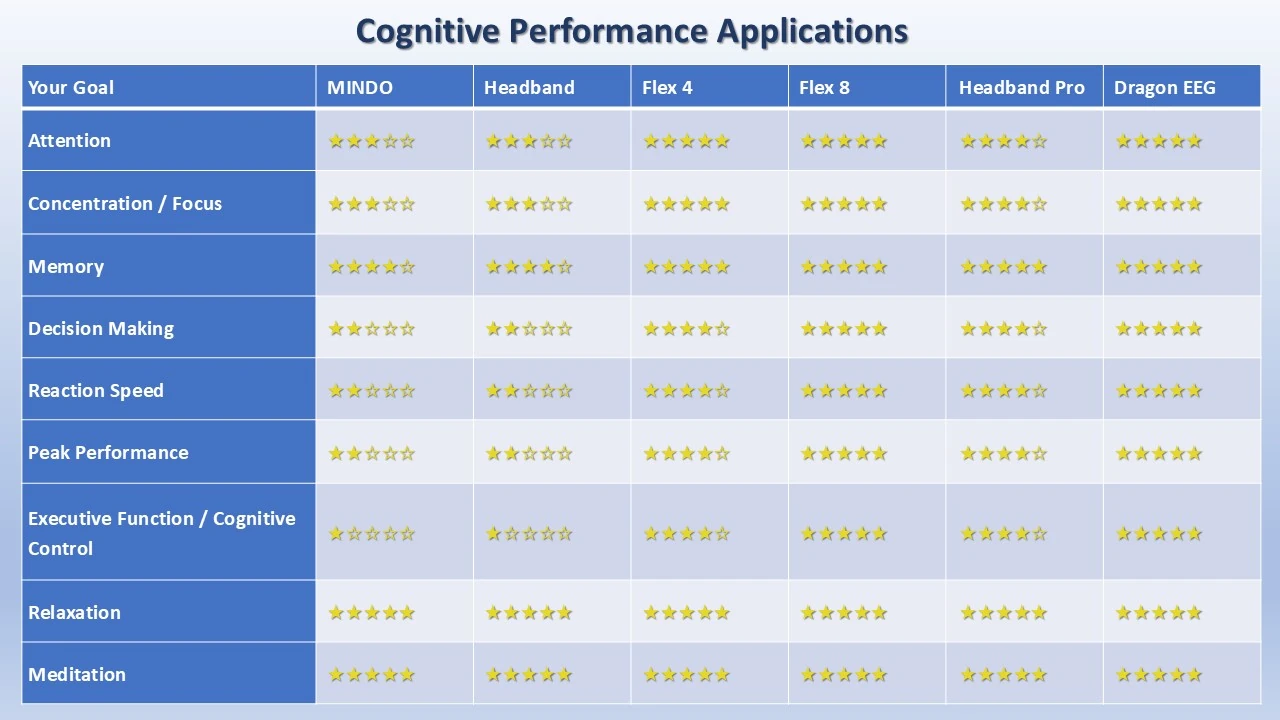
Cognitive Performance Applications – Which Device for Which Goal?
Now that you understand which brain regions each device can access, let’s look at specific cognitive goals.
The table below shows how effective each device is for different cognitive performance applications.
How to read the ratings:
Rating Meaning
★★★★★ Most effective choice. Full electrode access to the required brain regions.
★★★★☆ Very effective. Minor limitation (e.g., missing one optimal site).
★★★☆☆ Effective. Notable limitation (e.g., requires trade-off with other functions).
★★☆☆☆ Can help. Significant limitation (e.g., missing key electrode sites).
★☆☆☆☆ Minimal effectiveness. Cannot access primary brain regions for this function.
Remember: These ratings are based on electrode coverage – not on the quality of the device itself. Every BrainBit device is built with the same high-quality EEG technology. The difference is in which brain regions they can access.
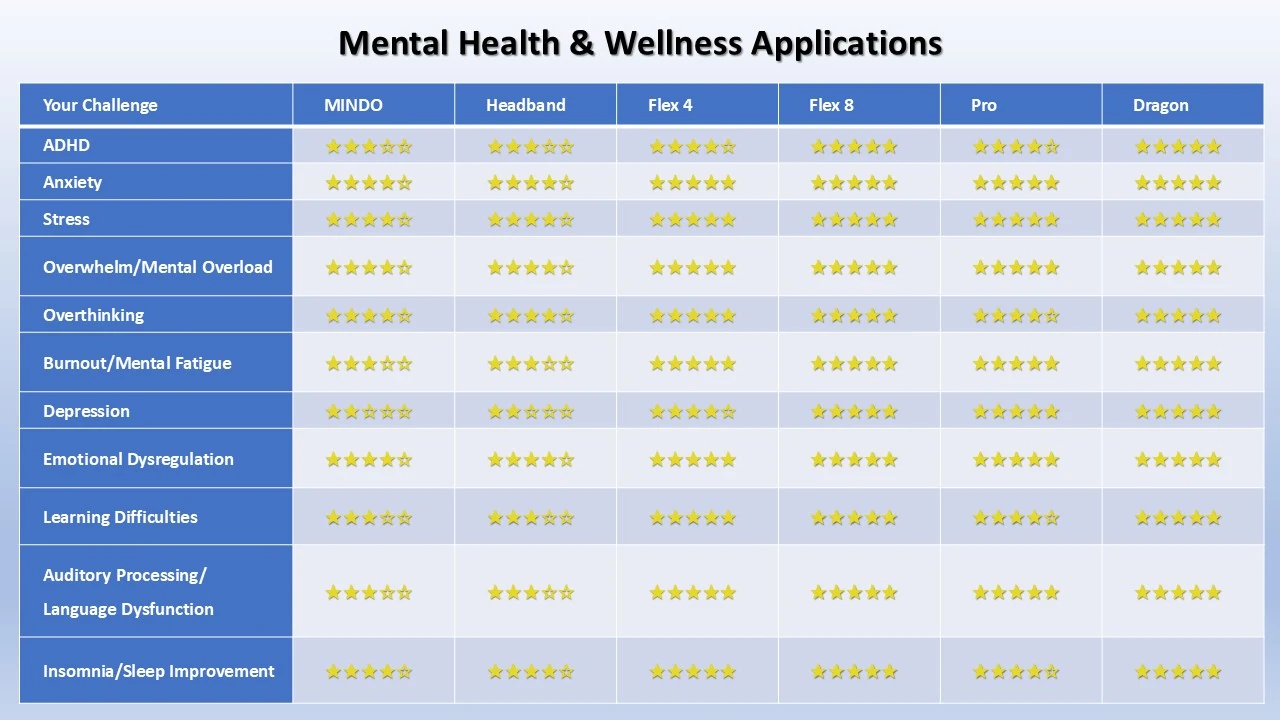
Mental Health & Wellness Applications – Which Device for Which Challenge?
Beyond cognitive performance, many people turn to neurofeedback for mental wellness and self-regulation. Whether you are dealing with daily stress, anxiety, overthinking, or sleep difficulties, neurofeedback can help you develop greater awareness and control over your mental states.
Important Note: BrainBit devices are non-medical neurofeedback training tools for wellness and self-regulation. They do not diagnose, treat, or cure medical conditions. Always consult with a qualified healthcare professional for medical concerns.
The table below shows how effective each device is for different mental wellness applications.
How to read the ratings
Rating Meaning
★★★★★ Most effective choice. Full electrode access to required brain regions.
★★★★☆ Very effective. Minor limitation (e.g., missing one optimal site).
★★★☆☆ Effective. Notable limitation (e.g., requires trade-off with other functions).
★★☆☆☆ Can help. Significant limitation (e.g., missing key electrode sites).
★☆☆☆☆ Minimal effectiveness. Cannot access primary brain regions for this function.
Frequently Asked Questions
No. BrainBit devices are designed for home use with intuitive apps and app-guided sessions. While this guide helps you choose the right tool for your goals, the software handles the complex data processing and guides you through sessions step by step.
Neurofeedback is a training process, much like learning an instrument or exercising. Some users notice subtle improvements—such as improved focus or calmer responses to stress—within a few sessions, but lasting changes typically emerge over weeks of consistent practice.
Yes. MINDO is specifically designed for both adults and children with adjustable sizing and app-guided sessions. Always supervise children during use, as these remain wellness tools and not medical treatments.
Consistency is more important than duration. Most users start with 15–20-minute sessions, 3–4 times per week. Like any training, regular practice over time is key to building new brain habits.
QEEG (Quantitative EEG) compares your brain activity against a normative database. It acts like a “brain blueprint,” showing you exactly which areas are imbalanced so you can train with precision instead of guessing which protocols to use.
Yes, particularly with the Flex 8, Pro, or Dragon models. These devices have enough electrode coverage to allow you to train multiple brain functions (e.g., focus and stress reduction) either simultaneously or in alternating sessions.
No. BrainBit devices are non-medical neurofeedback tools intended for wellness, self-regulation, and cognitive training. They do not diagnose or treat medical conditions; always consult a healthcare professional for medical concerns.
Safety & Troubleshooting – Getting the Best from Your Neurofeedback Training
Welcome to your neurofeedback journey. While BrainBit devices provide high-quality data, effective brain training is a partnership between you and your equipment. Please read these guidelines thoroughly before your first session.
Understanding Brain States – Simplified
Think of your brain as a sophisticated engine. These three “system states” are the foundation of your training:
The “Idle” State (SMR at Cz) – Think of this as “The Reset Button for the Thalamus.” Like a car idling smoothly in neutral—the engine is on, but the car isn’t revving unnecessarily. This state promotes calm, focused attention without overactivation.
The “Quiet” State (High Beta Down-training) – Think of this as “The Volume Knob for the Racing Mind.” Just as you turn down the volume on a noisy room to fall asleep, you are teaching your brain how to turn down high-frequency chatter that interferes with relaxation and sleep.
The “Balanced” State (Frontal Alpha Asymmetry at Fp1/Fp2) – Think of this as “Emotional De-cluttering.” If you are lying in bed worrying about tomorrow, you are stuck in “Problem-Solving Mode.” This protocol helps shift you into “Observation Mode,” where you can observe thoughts without becoming entangled in them.
The “Golden Rules” of Home Training
- Start Slow: The 10–15 Minute Rule
Your brain is learning a new skill. Begin with 10–15-minute sessions for the first two weeks. Over-training can lead to “neuro-fatigue,” headaches, or the opposite of your intended result. Neurofeedback is a training process, not a stimulation process – more is not better. - The Morning Window
Training is best performed during the first half of the day. Avoid neurofeedback within 4–6 hours of your planned bedtime to prevent “rebound alertness.” A successful session can create an alertness spike that interferes with sleep onset. - Consistency Over Duration
One 15-minute session done regularly (3–4 times per week) is significantly more effective than one long, exhausting hour once a week. Your brain learns through repetition, not intensity.
Signal Quality: The Key to Success
Neurofeedback is only as accurate as the signal it receives. Poor signal quality leads to “artifact training”—you may accidentally reinforce muscle tension (EMG) or eye blinks rather than brain rhythms.
Preparation:
- Ensure your skin is clean and free of oils or lotions at the contact points.
- Ensure the headband is snug and properly positioned according to the protocol guide.
Impedance Check: If your app indicates poor signal quality or high impedance, do not start the training. Wait until the signal stabilizes. Training through a noisy, low-quality signal is ineffective and may produce unwanted results.
Monitoring Your Response (The “Stop” Protocol)
Neurofeedback is a powerful tool. If you experience any of the following, end the session immediately and rest:
- Increased irritability or anxiety
- Persistent headaches or dizziness
- A feeling of “brain fog” or disorientation
- Difficulty falling asleep after an evening session
The 24-Hour Rule: If you feel worse 24 hours after a session, you are likely over-training or using a protocol that doesn’t fit your specific EEG profile. Reduce the session time by 50%, change the time of day, or switch to a calming protocol (such as SMR or Alpha-Theta) for your next session.
Troubleshooting Common Issues
“I don’t feel anything.”
This is normal! Neurofeedback works below the level of conscious awareness. Focus on staying calm, keeping your eyes soft, and following the app’s prompts. The “feeling” of improvement will come as a gradual change in your daily life.
“The feedback isn’t changing.”
Check your electrode placement. Ensure the headband is snug and properly positioned according to the specific protocol guide. Also check signal quality—poor contact can prevent the system from detecting changes in your brain activity.
“I feel ‘wired’ after training.”
You have likely trained at a frequency that was too stimulating for your current state. Reduce your session time by half, or switch to a “calming” protocol (such as SMR or Alpha-Theta) for your next session. Also ensure you are training in the morning, not the evening.
“I had trouble sleeping after training.”
This is a common sign of training too late in the day or over-training. Follow the Morning Window rule (train at least 4–6 hours before bedtime) and reduce session duration to 10 minutes until your sleep normalizes.
Important Disclaimer
These protocols are for educational and wellness purposes only. They do not constitute medical advice, diagnosis, or treatment. If you are currently under the care of a physician for a neurological or psychiatric condition, or if you suspect you have a clinical disorder, consult your healthcare provider before beginning any home neurofeedback training.
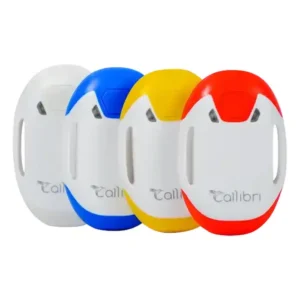
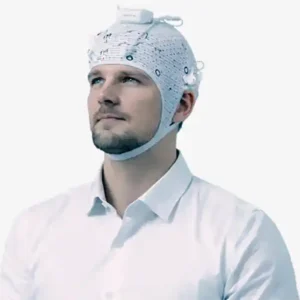
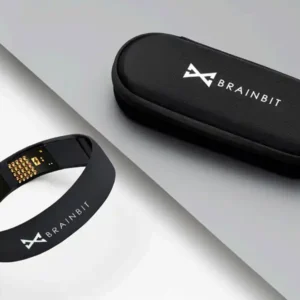
BrainBit Family For Cognition Enhancement
Find Related Articles To Make The Correct Choice
- adhd
- anxiety
- anxiety relief
- biofeedback
- brain training
- brainwaves
- breathing exercises biofeedback
- deep breathing
- depression
- eeg headset
- gaming addiction
- headache diary
- headache types
- home brain training
- HRV
- HRV biofeedback
- hypertension
- meditation
- migraine tracker
- nervous system
- neurofeedback
- neurofeedback for children
- neurofeedback for kids
- neuromodulation
- paced breathing
- parenting
- peak performance
- PTSD
- Raynaud's
- resonance frequency
- safety
- sleep
- stress relief
- temperature biofeedback
- vagal tone
- vagus nerve
- vagus nerve stimulation
- wearables

Do you feel paralyzed by irrational fears or phobias that control your life? Fear therapy offers a revolutionary, science-backed solution...
Burnout is more than just feeling tired or stressed — it’s a state of emotional, mental, and physical exhaustion caused...

Anxiety disorders are some of the most prevalent mental health challenges, often severely impacting a person’s ability to live a...