
Description
Are you searching for real migraine relief? You are not alone. The throbbing pain, the sensitivity to light and sound, the lost hours—it is exhausting. Most people try to cope, but true migraine relief begins not with a pill, but with a plan. This book, Stop the Migraine Loop (Quick Start Edition), is your complete migraine treatment guide. Inside, you will learn how to use a migraine diary to uncover your unique triggers and achieve an accurate migraine diagnosis. You will master instant migraine relief techniques for when an attack strikes. Finally, you will follow a structured 4-week reset plan to build a resilient brain and achieve lasting freedom.
Your journey to control starts here.
Are you sure your headache is actually a migraine?
You may experience severe headaches and assume—or have even been told—that you have migraines. But not every headache is a migraine, and an incorrect migraine diagnosis leads to the wrong treatment.
This book guides you from alpha to omega: from verifying your migraine diagnosis using clear, science-based criteria, to tracking your unique pattern, to managing attacks with precision. You’ll stop guessing whether your pain is “really” a migraine and start using a system built for what you actually have.
Choose Your Format
Get the Stop the Migraine Loop Guide in the format that works best for you. All versions include the same complete content: diagnostic worksheets, quizzes, infographics, First-Responder Toolkit, and PMMS. But for interactive or printable worksheets, choose the paperback book, interactive PDF, or print-ready PDF format.





What Is the Migraine Loop and Why Do You Feel Trapped?
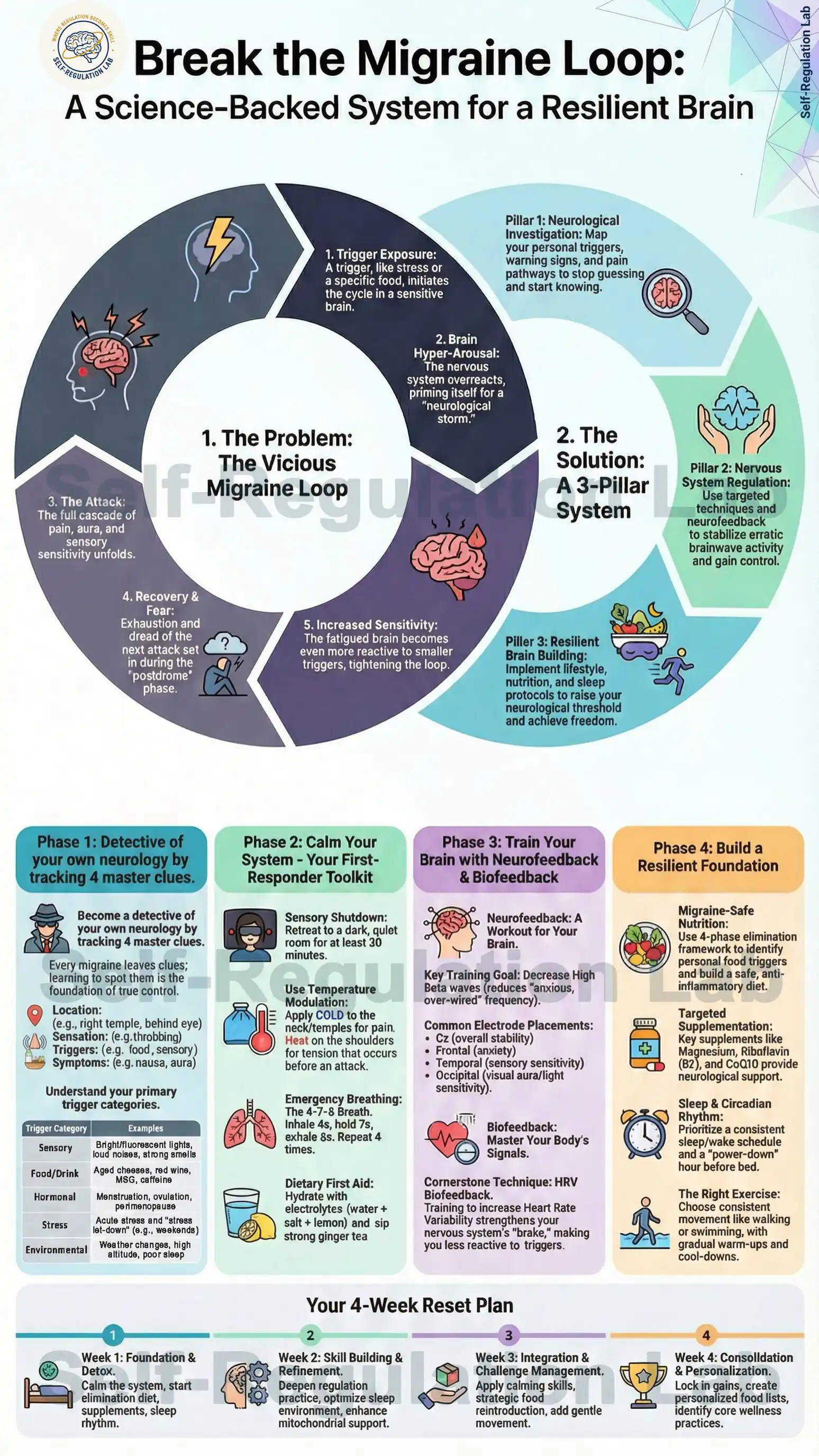
You feel trapped because your brain has learned a dysfunctional pattern: the migraine loop —a repeating neurological cycle that keeps triggering new attacks.
A trigger—stress, a food, a change in weather—can push your already sensitive nervous system past its threshold—what many people experience as a “storm”. You react with pain, recover with exhaustion, and then live in fear of the next attack. This cycle is why most people never find lasting migraine relief.
At the same time, you may have noticed something confusing: the same trigger does not always lead to the same result. Sometimes it causes a migraine. Other times, nothing happens.
This inconsistency is what keeps people stuck. It creates the feeling that migraines are something you can only react to—not understand or influence. But it reflects changes in your system.
Most approaches focus on identifying triggers. While this is useful, it is incomplete. Migraines occur when a trigger meets a sensitized nervous system. This is the missing piece: your brain and body have varying levels of sensitivity.
When your nervous system sensitivity is high, even a small trigger can lead to an attack. When it is low, the same trigger may have no effect.
Understanding the Loop
A migraine is not a single event. It is part of a repeating process:
- your system becomes gradually more sensitive
- your tolerance to triggers decreases
- an attack occurs
- after the attack, the system does not fully reset, and recovery remains incomplete
- baseline sensitivity stays elevated
Over time, this creates a loop in which each episode increases the likelihood of the next.
This is why migraines often feel like they are “coming back” without a clear reason.
Why This Loop Keeps You Stuck
Many people focus only on the pain stage. They try to stop the migraine once it has already started. However, by that point, the neurological cascade is already in motion.
As a result:
- relief becomes temporary
- attacks return
- triggers seem random
This is why traditional approaches often fail. They treat symptoms, but they do not interrupt the loop itself.
The Key Shift: From Reaction to Control
To achieve meaningful migraine relief, you need to understand what happens before the attack—not just during it.
This is where a migraine diary becomes essential. Instead of guessing, you begin to:
- track patterns
- recognize early warning signs
- identify your personal triggers
- intervene before the attack escalates
This shift changes everything. It moves you from passive suffering to active control. This is the point where migraine treatment becomes structured rather than reactive.
Your First Breakthrough
The moment you see your migraine as a predictable loop, not a random event, you gain your first real advantage.
You are no longer asking: “Why is this happening again?”
Instead, you begin asking: “Where am I in the loop—and what can I do right now?”
That is the starting point for instant migraine relief strategies and long-term change.
Your Migraine Diary: How to Map Your Unique Migraine Fingerprint
Most people try to manage migraines by reacting to pain. They wait until the attack begins, then look for migraine relief. This is why results are often inconsistent. The real shift happens when you stop reacting—and start tracking. Your migraine diary is the tool that turns “Why did this happen?” into “I know exactly what comes next.”
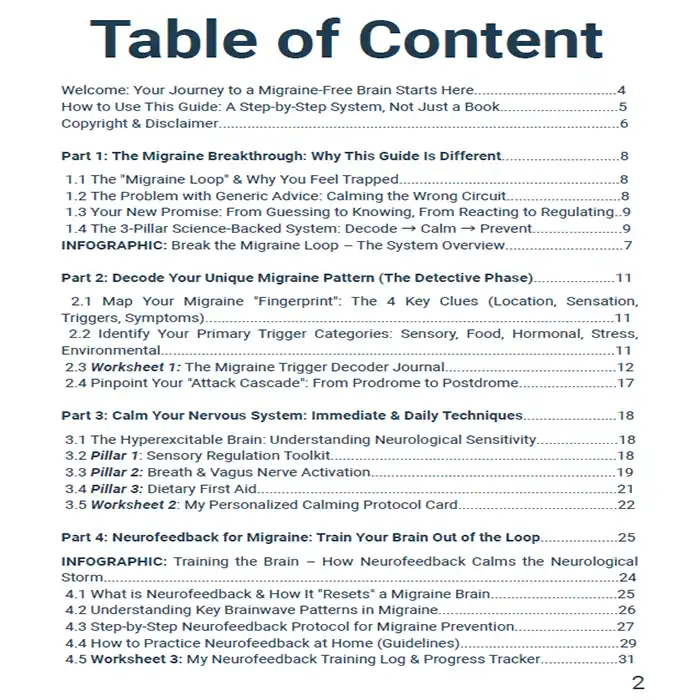
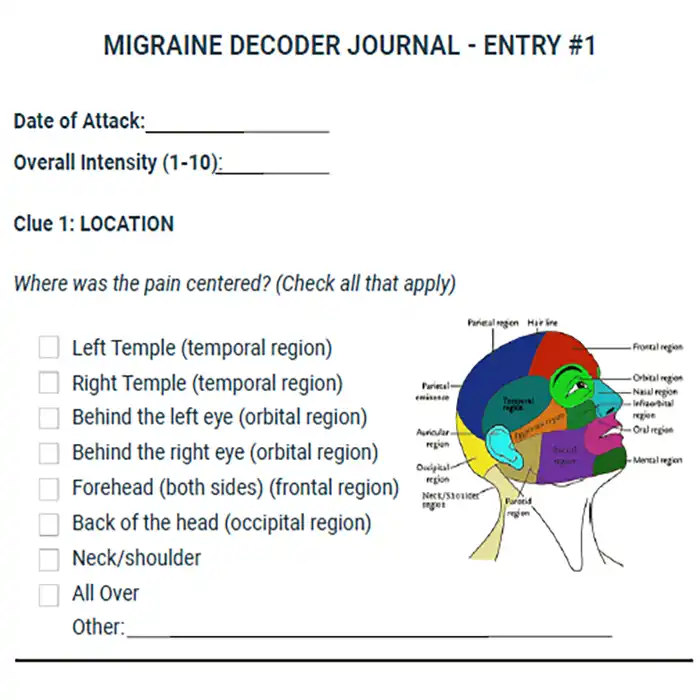
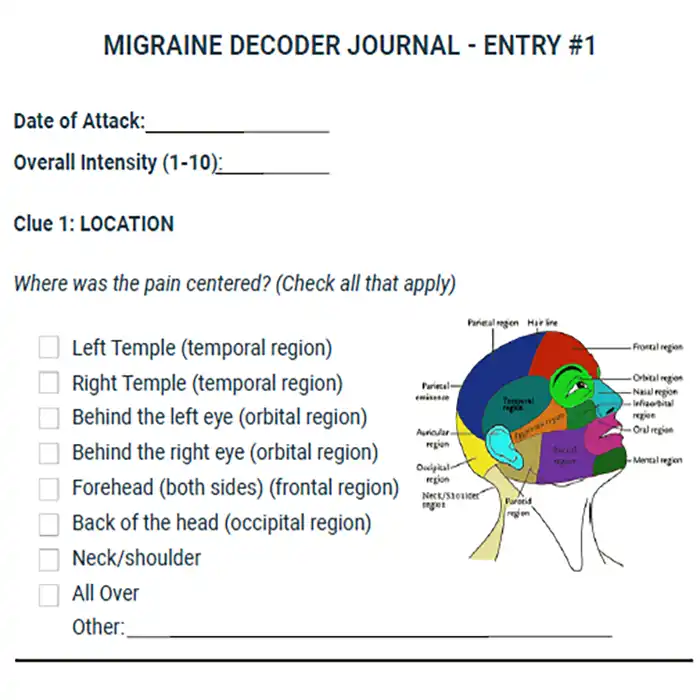
The first step to migraine relief is knowing what you are dealing with. A migraine diary is your most powerful tool for that. In Part 2 of this book, you will complete Worksheet 1: The Migraine Trigger Decoder Journal.
At first glance, a migraine diary may seem simple. You write down when a migraine happens and what you feel. Used correctly, it becomes much more than a record. It becomes a decision-making tool. That difference is powerful and changes how you respond.
This system helps you track the 4 Key Clues: location, sensation, triggers, and accompanying symptoms. Over time, these observations reveal patterns you have never noticed. This is how you move from a vague migraine diagnosis to a precise, personal map of your pain.
When you track consistently, patterns begin to emerge, and you begin to uncover:
- repeating triggers (food, stress, sleep changes)
- early warning signs (fatigue, mood shifts, neck tension)
- symptom progression (from mild discomfort to full attack)
- recovery patterns
These patterns are not obvious at first. But once they become visible, your timing improves.
The Key Advantage: Timing for Instant Migraine Relief
Timing is critical for instant migraine relief. If you act too late, options become limited. If you act early, you can often reduce intensity—or even prevent the attack.
Your tracking helps you identify:
- your personal prodrome phase (early warning window)
- your most reliable triggers
- your most effective responses
This gives you a practical advantage.
How This Diary Works Differently
This is not just a log of symptoms. It is a structured system designed to guide you through three steps:
- Identify patterns: location of pain, type of sensation, triggers, associated symptoms
- Understand progression: what happens before each attack, which triggers matter most, and how your symptoms evolve.
- Act early: apply targeted responses for instant migraine relief, use daily practices to reduce sensitivity, and perform long-term adjustments for better migraine treatment outcomes.
At this stage, something important changes. Migraines no longer feel random or uncontrollable. Instead, they become:
- observable
- measurable
- and possible to influence
You begin to understand your own patterns with clarity—and that gives you a level of control most people never reach.
Understanding the Migraine Attack Cascade
By now, you have started identifying your migraine fingerprint using a structured migraine diary. You can see patterns, triggers, and symptoms more clearly.
However, there is another critical layer to understand: a migraine is not a single event. It is a process that unfolds over time. This process is called the migraine attack cascade.
Why the Attack Cascade Matters
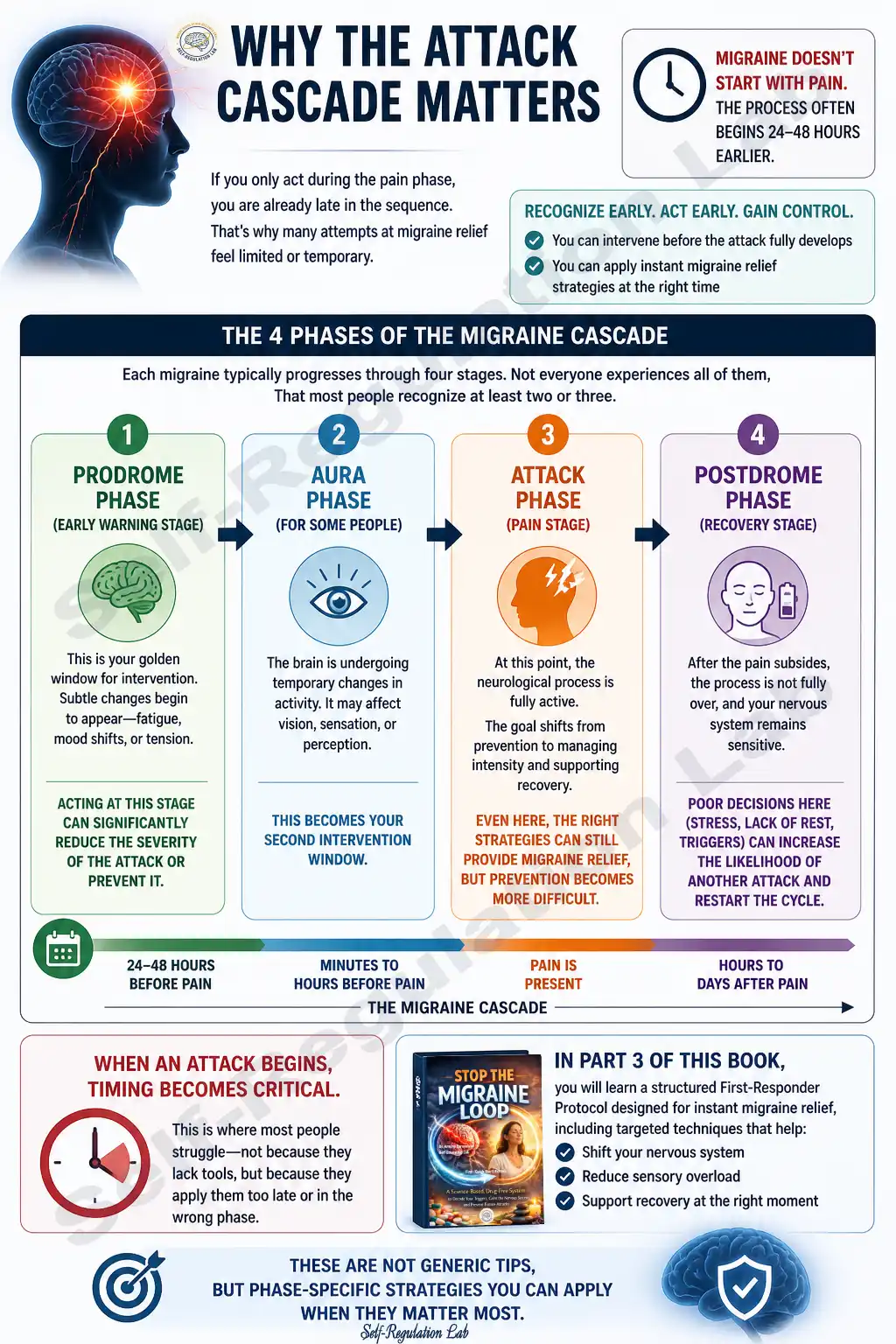
Most people think a migraine begins when the pain starts. In reality, the process often begins 24–48 hours earlier.
If you only act during the pain phase, you are already late in the sequence. That is why many attempts at migraine relief feel limited or temporary.
But if you learn to recognize earlier stages, you gain a powerful advantage:
- You can intervene before the attack fully develops
- You can apply instant migraine relief strategies at the right time.
The 4 Phases of the Migraine Cascade
Each migraine typically progresses through four stages. Not everyone experiences all of them, but most people recognize at least two or three.
1. The Prodrome Phase (Early Warning Stage). This is your golden window for intervention. Subtle changes begin to appear—fatigue, mood shifts, or tension. Acting at this stage can significantly reduce the severity of the attack or prevent it.
2. The Aura Phase (For Some People). The brain is undergoing temporary changes in activity. It may affect vision, sensation, or perception. This is a clear signal that the migraine is progressing. This becomes your second intervention window.
3. The Attack Phase (Pain Stage). At this point, the neurological process is fully active. The goal shifts from prevention to managing intensity and supporting recovery. Even here, applying the right strategies can still provide migraine relief, but prevention becomes more difficult.
4. The Postdrome Phase (Recovery Stage). After the pain subsides, the process is not fully over, and your nervous system remains sensitive. Your brain is still vulnerable. Poor decisions here (stress, lack of rest, triggers) can increase the likelihood of another attack and restart the cycle.
When an attack begins, timing becomes critical.
This is where most people struggle—not because they lack tools, but because they apply them too late or in the wrong phase.
In Part 3 of this book, you will learn a structured First-Responder Protocol designed for instant migraine relief, including targeted techniques that help shift your nervous system, reduce sensory overload, and support recovery at the right moment. These are not generic tips, but phase-specific strategies you can apply when they matter most.
Why This Changes Your Strategy
When you combine the migraine fingerprint with the attack cascade, something important happens:
You stop seeing migraines as isolated events.
Instead, you see:
- a timeline
- a sequence
- a predictable progression
This understanding is essential for effective migraine treatment.
Using Your Diary with the Migraine Cascade
At this stage, your migraine diary becomes even more powerful.
Instead of only recording pain, you begin tracking:
- early prodrome signals
- timing between phases
- duration of each stage
- what helped at each point
This allows you to answer key questions:
- When do my migraines really begin?
- What is my earliest warning sign?
- When is my best moment to act?
In the book, you will find a detailed breakdown of each phase of the migraine cascade, along with precise guidance on how to respond at each stage—so you can interrupt the process early, reduce intensity, and improve long-term migraine outcomes.
Instant Migraine Relief — Your First-Responder Toolkit
What does “instant migraine relief” really mean?
True instant migraine relief is not magic—it is timing. The techniques in this book can significantly reduce pain and shorten an attack within minutes, but they are most effective when you act early.
The secret is recognizing your prodrome (the early warning phase, hours or even days before pain) or aura (the sensory changes just before onset). Intervene here, and you can often stop the attack before it fully escalates. Wait until the pain phase, and your options become limited.
By now, you understand the migraine loop, your personal migraine fingerprint, and the attack cascade.
The next question becomes practical: “What do you do when the first signs appear?”
This is where most people lose control—not because they lack solutions, but because they apply them too late or without a clear system.
This chapter introduces a structured first-response approach designed for instant migraine relief, especially when applied at the earliest stages.
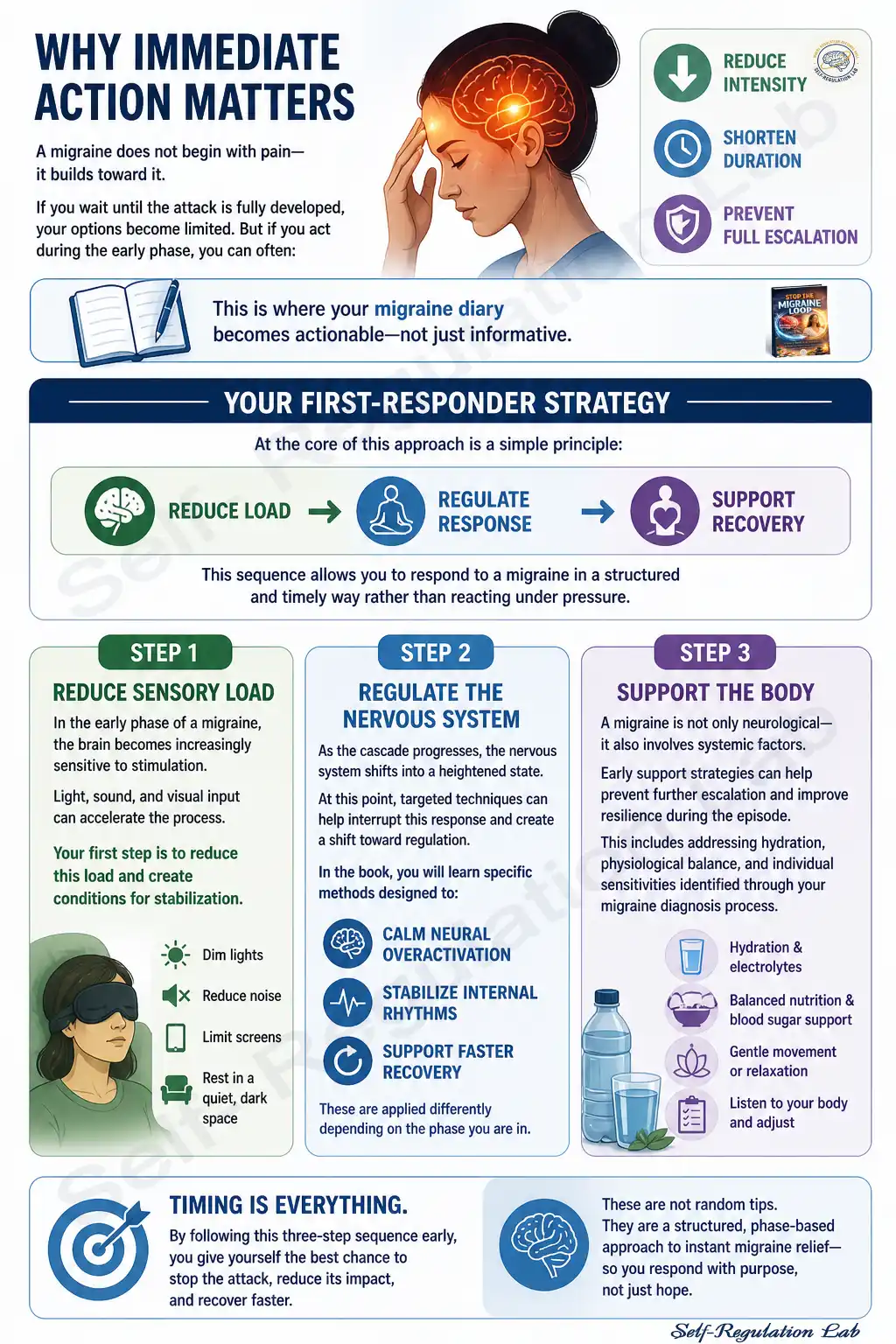
Why Immediate Action Matters for Migraine Relief
A migraine does not begin with pain—it builds toward it. If you wait until the attack is fully developed, your options become limited. But if you act during the early phase, you can often:
- reduce intensity
- shorten duration
- prevent full escalation
This is where your migraine diary becomes actionable—not just informative.
Your First-Responder Strategy
At the core of this approach is a simple principle:
Reduce load → Regulate response → Support recovery
This sequence allows you to respond to a migraine in a structured and timely way rather than reacting under pressure.
Step 1: Reduce Sensory Load
In the early phase of a migraine, the brain becomes increasingly sensitive to stimulation. Light, sound, and visual input can accelerate the process. Your first step is to reduce this load and create conditions for stabilization.
Step 2: Regulate the Nervous System
As the cascade progresses, the nervous system shifts into a heightened state.
At this point, targeted techniques can help interrupt this response and create a shift toward self-regulation.
In the book, you will learn specific methods designed to:
- calm neural overactivation
- stabilize internal rhythms
- support faster recovery
These are applied differently depending on the phase you are in.
Step 3: Support the Body
A migraine is not only neurological—it also involves systemic factors.
Early support strategies can help prevent further escalation and improve resilience during the episode. This includes addressing hydration, physiological balance, and individual sensitivities identified through your migraine diagnosis process.
Personalizing Your Toolkit for Migraine Relief
Not every strategy works the same way for everyone. This is why your migraine fingerprint matters. Over time, you build a personalized first-responder system based on:
- your triggers
- your early signals
- your most effective responses
Your migraine diary becomes the tool that refines this process.
What Makes This Approach Different
Most advice focuses on isolated techniques. This system focuses on:
timing + sequence + personalization
You are not just applying methods—you are applying them at the right moment, in the right order.
This is what makes instant migraine relief more reliable.
From Reaction to Preparedness
At this stage, something shifts. You are no longer reacting to migraines when they become overwhelming.
You are:
- recognizing early changes
- responding with intention
- tracking outcomes
- refining your approach
This is the foundation of consistent migraine treatment.
What You Will Learn in the Book
In the full chapter, you will find a detailed First-Responder Protocol, including precise techniques, timing strategies, and phase-specific actions designed to help you intervene early, reduce intensity, and regain control during an attack.
Mind-Body Techniques to Reduce Brain Sensitivity
Up to this point, you have learned how to:
- recognize your migraine patterns
- track them using a migraine diary
- and act early for instant migraine relief
These steps give you control over individual attacks. But there is a deeper question: “How can you reduce the sensitivity of your system in the first place?” Because the more sensitive your brain and body are, the easier it is for triggers to activate the migraine cascade.
This is where mind-body training methods come in.
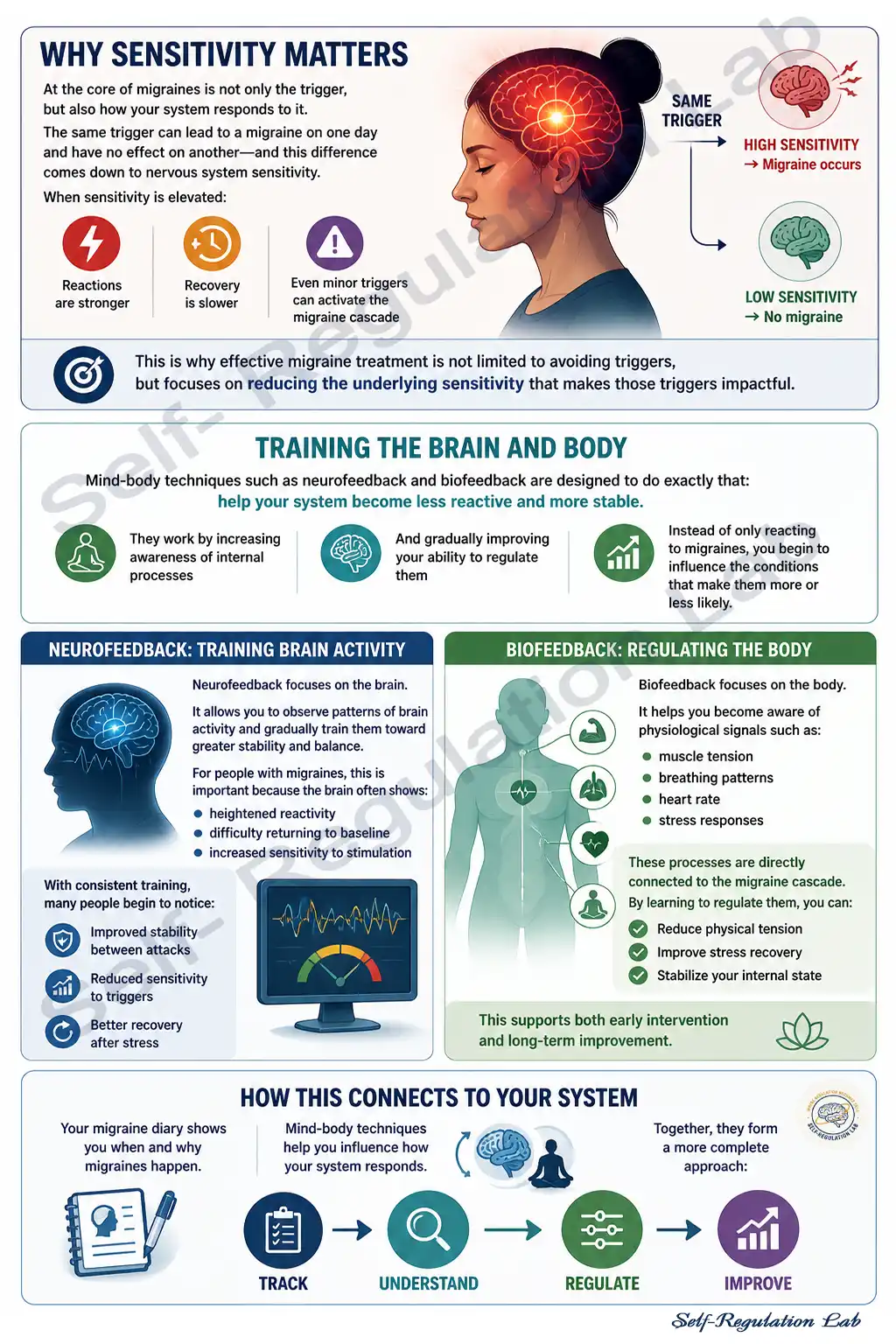
Why Sensitivity Matters for Migraine Relief
At the core of migraines is not only the trigger, but also how your system responds to it. The same trigger can lead to a migraine on one day and have no effect on another—and this difference comes down to nervous system sensitivity. When sensitivity is elevated, reactions are stronger, recovery is slower, and even minor triggers can activate the migraine cascade. This is why effective migraine treatment is not limited to avoiding triggers, but focuses on reducing the underlying sensitivity that makes those triggers impactful.
Training the Brain and Body
Mind-body techniques such as neurofeedback and biofeedback are designed to do exactly that: help your system become less reactive and more stable. They work by increasing awareness of internal processes and gradually improving your ability to regulate them. Instead of only reacting to migraines, you begin to influence the conditions that make them more or less likely.
Neurofeedback: Training Brain Activity
Neurofeedback focuses on brain activity. It allows you to observe patterns of brain activity and gradually train them toward greater stability and balance. For people with migraines, this is important because the brain often shows:
- heightened reactivity
- difficulty returning to baseline
- increased sensitivity to stimulation
With consistent training, many people begin to notice:
- improved stability between attacks
- reduced sensitivity to triggers
- better recovery after stress
Biofeedback: Regulating the Body
Biofeedback focuses on the body. It helps you become aware of physiological signals such as:
- muscle tension
- breathing patterns
- heart rate
- stress responses
These processes are directly connected to the migraine cascade. By learning to regulate them, you can:
- reduce physical tension
- improve stress recovery
- stabilize your internal state
This supports both early intervention and long-term improvement.
How This Connects to Your System
Your migraine diary shows you when and why migraines happen. Mind-body techniques help you influence how your system responds.
Together, they form a more complete approach:
Track → Understand → Regulate → Improve
A Different Level of Control
At this stage, your role begins to change. You are no longer only:
- reacting to attacks
- or trying to avoid triggers
You are actively working to reduce the underlying sensitivity that drives the migraine loop.
This is what makes long-term migraine relief more achievable.
What You Will Learn in the Book
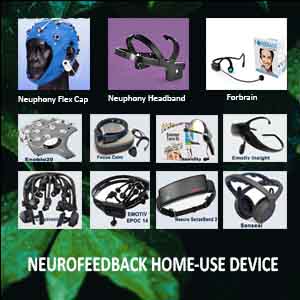
In the book, you will find a detailed and practical guide to using neurofeedback and biofeedback for migraine management. You will learn how these techniques work in the context of migraines, how to choose the right approach based on your specific pattern, and how to select appropriate devices for home use or professional training.
The chapters include clear explanations of:
- how to match neurofeedback and biofeedback methods to your migraine type
- how to use these techniques safely and effectively
- how to build a structured training routine
- how to integrate them with your migraine diary and overall migraine treatment strategy
This is not a general overview—it is a step-by-step framework designed to help you apply these methods correctly and achieve measurable improvement in sensitivity, control, and long-term migraine relief.
From Relief to Control — Your Migraine Relief and Prevention System
By this point, you understand how migraines develop, how to track them, and how to act early for migraine relief. But understanding alone is not enough. The real change happens when you begin to apply these principles consistently—so your system becomes more stable, less reactive, and easier to manage.
This is where everything comes together.
A Structured Path, Not Random Effort
Most people try to manage migraines by doing many things at once—changing diet, avoiding triggers, trying different techniques—often without a clear structure. This usually leads to inconsistent results. Instead, this system follows a simple progression:
- first, you observe and track
- then, you act early
- then, you stabilize your system
- and finally, you refine what works for you
This is how you move from reacting to migraines → to predicting and influencing them.
Building Control Step by Step
Rather than trying to “fix everything,” you gradually build control in layers. You begin by using your migraine diary consistently, not only during attacks but throughout the day. This allows you to see patterns that were previously hidden—early signals, repeating triggers, and how symptoms develop over time.
Once these patterns become clear, your focus shifts to timing. Instead of waiting for pain, you begin to act at the earliest signs—when intervention is most effective. This is where instant migraine relief strategies start to make a real difference.
At the same time, you begin working on your baseline state. Small daily adjustments—reducing unnecessary stress, improving consistency in sleep and routine, and supporting your nervous system—gradually lower your overall sensitivity. This makes your system less reactive and improves recovery between episodes.
Finally, you refine your approach. You identify what actually works for you, remove what doesn’t, and build a simplified, personalized system you can rely on.
What Changes Over Time
When you follow this structured approach, several shifts begin to happen:
- migraines feel less random
- early warning signs become clearer
- interventions become more effective
- recovery becomes easier
Most importantly, you begin to experience a different level of control. Instead of reacting late, you are acting at the right time, with the right strategy.
Prevention: The Missing Piece
Relief during an attack is important. Early action is powerful. But long-term migraine treatment depends on something deeper: reducing the conditions that allow migraines to develop. This does not mean avoiding every trigger. It means improving your system’s ability to:
- tolerate stress
- recover efficiently
- maintain stability under changing conditions
This is what makes migraines less likely to start.
How Prevention Fits into the System
Prevention is built through small, consistent adjustments in daily life. You begin to notice:
- when your system is under a higher load
- when your tolerance is lower
- what supports stability and recovery
Your migraine diary becomes a tool not only for understanding attacks but also for anticipating and preventing them. Over time, this allows you to:
- adjust before overload builds
- protect recovery after stress
- reduce overall sensitivity
A Different Outcome
When these elements come together, the result is not just temporary relief. You develop:
- a working system you can rely on
- the ability to act early with confidence
- a more stable and resilient nervous system
- a personalized approach to migraine treatment
Migraines may not disappear overnight. But they become:
- more predictable
- less intense
- easier to manage
What You Will Find in the Book
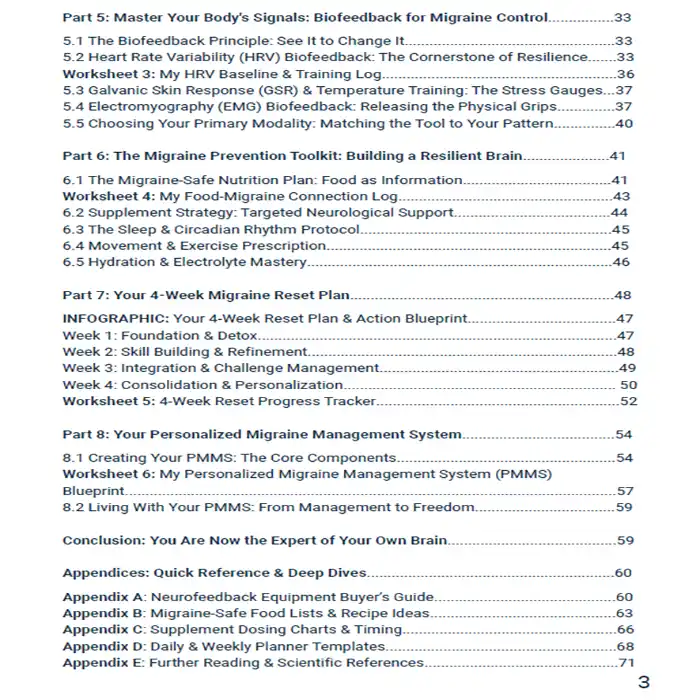
In the book, this process is presented as a structured, step-by-step reset plan, with clear guidance on what to focus on at each stage, how to apply the methods correctly, and how to build a system that fits your specific pattern.
You will not be left to guess.
You will follow a defined progression designed to help you move from confusion → to clarity → to consistent control.
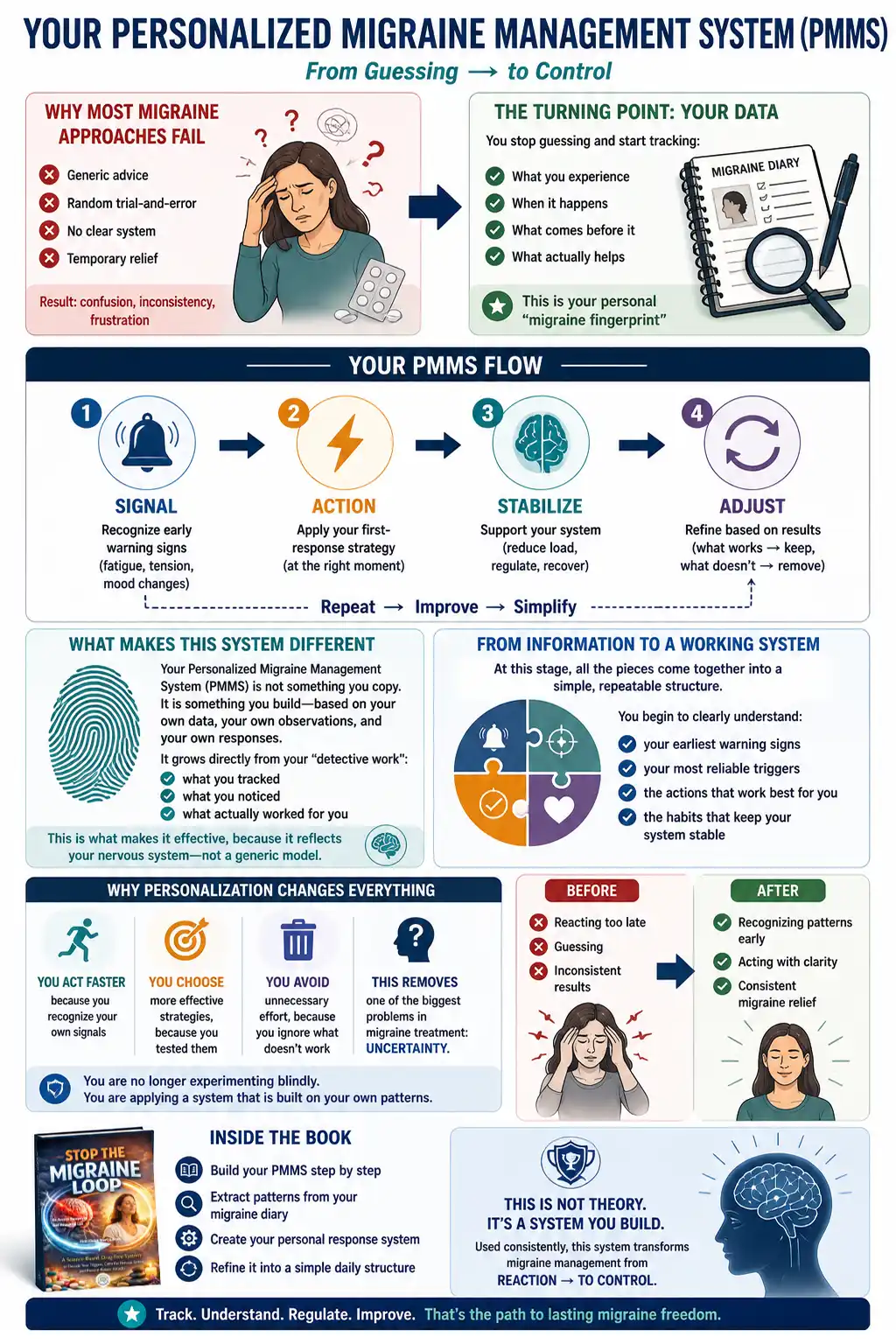
Your Personalized Migraine Management System (PMMS)
By now, you have seen something important. Migraines are not random. They follow patterns. And those patterns are yours. You have tracked them using a migraine diary, identified early signals, and learned how to act for instant migraine relief. Now comes the step that changes everything: turning this knowledge into a system that works specifically for you.
Why Generic Advice Fails
Most migraine advice is general. Avoid this. Try that. Change this habit. And sometimes it helps. Sometimes it doesn’t. Because it is not built around your patterns. Two people can:
- have different triggers
- experience different early signals
- respond to different strategies
Yet they are often given the same recommendations. This is why many people feel stuck between temporary migraine relief and recurring attacks.
What Makes This System Different
Your Personalized Migraine Management System (PMMS) is not something you copy. It is something you build—based on your own data, your own observations, and your own responses. It grows directly from your “detective work”:
- what you tracked
- what you noticed
- what actually worked for you
This is what makes it effective. Because it reflects your nervous system—not a generic model.
From Information to a Working System
At this stage, all the pieces come together into a simple, repeatable structure. You begin to clearly understand:
- your earliest warning signs
- your most reliable triggers
- the actions that work best for you
- the habits that keep your system stable
Instead of thinking:
👉 “What should I try this time?”
You move to:
👉 “I know exactly what to do.”
Why Personalization Changes Everything
When your approach is personalized:
- You act faster, because you recognize your own signals
- You choose more effective strategies, because you tested them
- You avoid unnecessary effort, because you ignore what doesn’t work
This removes one of the biggest problems in migraine treatment: uncertainty. You are no longer experimenting blindly. You are applying a system that is built on your own patterns.
What This Gives You in Practice
A personalized system does not make migraines magically disappear. But it changes your experience completely. You begin to notice:
- attacks feel less sudden
- responses become more automatic
- recovery becomes more predictable
- overall control increases
Most importantly, you stop feeling dependent on trial-and-error solutions
A System That Evolves With You
Your PMMS is not fixed. As you continue to track and refine, it becomes more precise and efficient. Small adjustments—based on real observations—lead to continuous improvement over time. This is how long-term migraine relief becomes sustainable.
What You Will Build in the Book
In the book, you will be guided step by step to create your own Personalized Migraine Management System.
You will learn how to:
- extract the right patterns from your migraine diary
- identify the signals that truly matter
- select and organize your most effective responses
- build a clear, repeatable structure you can rely on daily
This is not a theoretical model. It is a practical system you will construct based on your own data—so it works in real life, not just in theory.
The Real Outcome
At the beginning, migraines may feel unpredictable and uncontrollable. With a personalized system, that relationship changes. You begin to:
- anticipate instead of react
- respond instead of guess
- influence instead of endure
And that is the point where migraine relief becomes more consistent—and long-term migraine treatment finally starts to work.
Who May Benefit from This Book
Who May Benefit from This Book
Not every approach to migraine relief works for everyone. In fact, one of the biggest reasons people struggle is because they follow generic advice that does not match their specific pattern.
This book is designed for people who want a more precise, structured, and practical way to understand and manage migraines—using a migraine diary and a step-by-step system.
This Book May Be Right for You If…
You will benefit most from this guide if you recognize yourself in one or more of the situations below.
- You experience recurring migraines
You deal with migraines regularly—whether weekly, monthly, or in unpredictable cycles—and you are tired of temporary fixes that do not last. - You want more than short-term solutions
You are not just looking for short-term solutions. Instead, you want lasting migraine treatment strategies that reduce frequency, intensity, and impact over time. - Your triggers feel inconsistent or unclear
Sometimes it seems obvious what caused your migraine. Other times, it feels completely random. A structured migraine diary can help you uncover hidden patterns and connections. - You notice early warning signs—but don’t know how to use them
You may already feel subtle changes before an attack—fatigue, mood shifts, neck tension, or cravings. This means you have a window for instant migraine relief if you know how to act in time. - Your migraines are influenced by stress or lifestyle factors
Sleep changes, emotional pressure, screen exposure, or daily habits seem to play a role—but you have not yet connected them into a clear system. This book helps you connect these factors into a clear system. - You prefer a drug-free or complementary approach
You may already be using medication, or you may want to reduce reliance on it. Either way, this guide provides non-invasive strategies that can support your overall migraine treatment plan. - You are ready to be active in the process
This book is not a passive reading experience. It is a practical system. If you are willing to use a migraine diary, follow simple steps, and observe your patterns, you will get the most value from this book.
Who This Book Is NOT For
To be clear, this guide may not be suitable if:
- You are looking for a quick, one-time fix without effort
- You prefer not to track symptoms or behaviors
- You expect instant results without consistency
Real progress comes from small, repeated actions—not from a single solution.
Frequently Asked Questions
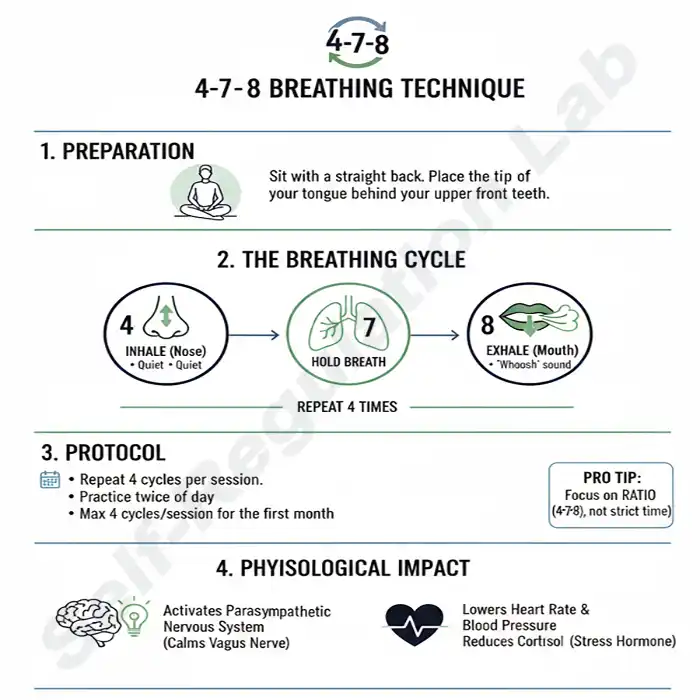
Yes. “Instant” means within minutes—not seconds. Techniques such as the 4-7-8 breath, sensory shutdown, and ginger tea can significantly reduce pain and shorten the duration of attacks for many people. These are not cures, but powerful tools for instant migraine relief .
Most migraine treatment guides focus only on medication or generic lifestyle advice. This book adds two unique layers: a migraine diary to decode your personal pattern and neurofeedback/biofeedback to retrain your nervous system.
Some people experience instant migraine relief from the breathing techniques immediately. The 4-Week Reset Plan is designed to show measurable progress within one month. Neurofeedback and biofeedback typically take 8-12 sessions to show lasting changes.
No. This book is an educational tool for migraine diagnosis and self-management. It is not a substitute for professional medical advice. Always consult your doctor, especially before starting supplements or neurofeedback.
No. The migraine diary and First-Responder Toolkit require nothing but a pen. The neurofeedback and biofeedback sections are included for those who want to go deeper, but they are optional. You can achieve significant migraine relief with the basic protocols alone.
What Our Readers Say
References
- Silberstein SD. Practice parameter: evidence-based guidelines for migraine headache (an evidence-based review). Report of the Quality Standards Subcommittee of the American Academy of Neurology. Neurology. 2000;55(6):754–762. https://pubmed.ncbi.nlm.nih.gov/10993991/
- Nestoriuc Y, Martin A. Efficacy of biofeedback for migraine: a meta-analysis. Pain. 2007;128(1–2):111–127. https://pubmed.ncbi.nlm.nih.gov/17084028/
- Holroyd KA, Penzien DB. Pharmacological versus non-pharmacological prophylaxis of recurrent migraine headache: a meta-analytic review. Pain. 1990;42(1):1–13. https://pubmed.ncbi.nlm.nih.gov/2146583/
- Schoenen J, Wang W, Albert A, Delwaide PJ. Potentiation instead of habituation characterizes visual evoked potentials in migraine patients between attacks. European Journal of Neurology. 1995;2(2):115–122. https://pubmed.ncbi.nlm.nih.gov/24283611/
- Burstein R, Noseda R, Borsook D. Migraine: multiple processes, complex pathophysiology. Journal of Neuroscience. 2015;35(17):6619–6629. https://www.jneurosci.org/content/35/17/6619
- Goadsby PJ, Holland PR, Martins-Oliveira M, Hoffmann J, Schankin C, Akerman S. Pathophysiology of migraine: a disorder of sensory processing. Physiological Reviews. 2017;97(2):553–622. https://journals.physiology.org/doi/full/10.1152/physrev.00034.2015
- Lazaridou A, Paschali M, Bernstein C, Curiel M, Moore S, Edwards RR. sEMG biofeedback for episodic migraines: a pilot randomized clinical trial. Appl Psychophysiol Biofeedback. 2024;49(2):271–279. https://pubmed.ncbi.nlm.nih.gov/38280149/
- Golshan F, Sun G, Francisco J, Alibolandi P, Nabi Zade M, Mousavi A, et al. Randomized controlled trial of neurofeedback mindfulness meditation as a practice for migraine management. J Clin Neurosci. 2025. https://pubmed.ncbi.nlm.nih.gov/41101279/
- 26. International Headache Society (ICHD-3 classification) https://ichd-3.org/