
Key takeaways
- What is neurofeedback? Neurofeedback is EEG biofeedback: it measures your brainwaves and gives real-time feedback so your brain learns to self-regulate.
- It works through operant conditioning, rewarding desired brainwave patterns with sounds or visuals until the pattern becomes easier to produce.
- Results build slowly over many sessions rather than in one sitting, and progress depends on consistent practice.
- Research is strongest for attention-related goals, but blinded studies show benefits can overlap with a placebo effect, so keep expectations grounded.
- You can train at home with a consumer EEG device or work with a clinician; the right choice depends on your goals and the complexity of what you want to address.
Neurofeedback is a form of brain training that measures your brainwave activity with sensors and feeds it back to you in real time, so your brain can gradually learn to shift into steadier, more useful patterns. In practice, that means you sit in front of a screen or listen to tones while a program rewards your brain whenever it produces the activity you are aiming for, and over many sessions that activity becomes easier to reach on your own.
The appeal is obvious for anyone looking for drug-free ways to manage stress, sharpen focus, or support a therapeutic goal. The reality is more nuanced than the marketing around it suggests. This guide explains what neurofeedback at a mechanical level is, how the feedback loop actually changes behavior, and what you can reasonably expect before you spend time or money on it.
What Is Neurofeedback, and How Does It Differ From Biofeedback?
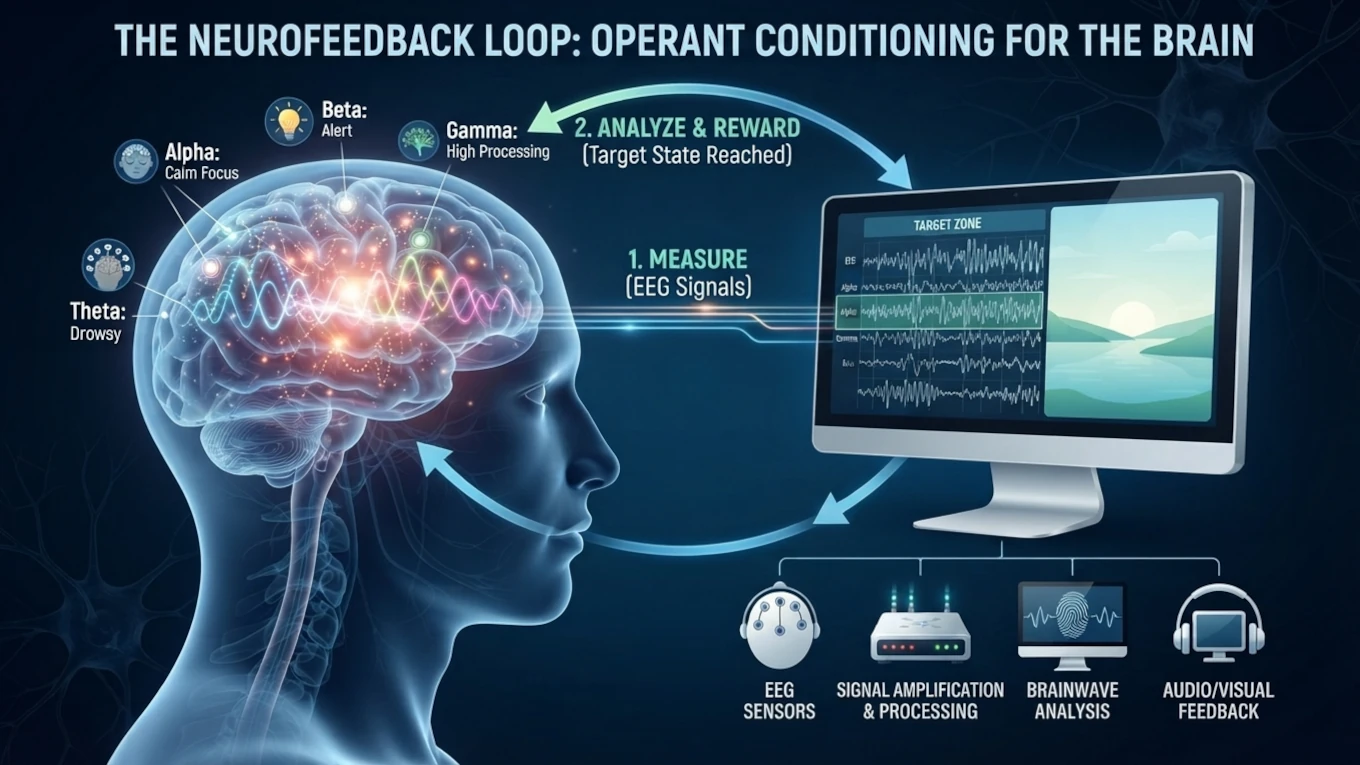
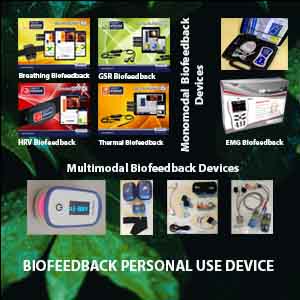
Neurofeedback is also called EEG biofeedback. And that second name is the clearest way to understand it. Biofeedback is the broad practice of measuring a body signal and showing it to you so you can influence it. Classic biofeedback tracks things like heart rate, breathing, skin temperature, or muscle tension. Neurofeedback narrows that idea down to one signal: the electrical activity of your brain, captured through an electroencephalogram, or EEG.
So every neurofeedback session is biofeedback, but not every biofeedback session is neurofeedback. If a sensor on your finger is showing your pulse, that is general biofeedback. If sensors on your scalp are showing your brainwaves, that is neurofeedback. Psychology Today describes neurofeedback as a therapeutic intervention that gives immediate feedback from a computer program assessing a client’s brainwave activity, capturing the core idea: measure the brain, then reflect it back fast enough that you can respond. You can read its plain-language overview in the Psychology Today guide to neurofeedback.
How Neurofeedback Works: EEG and the Feedback Loop
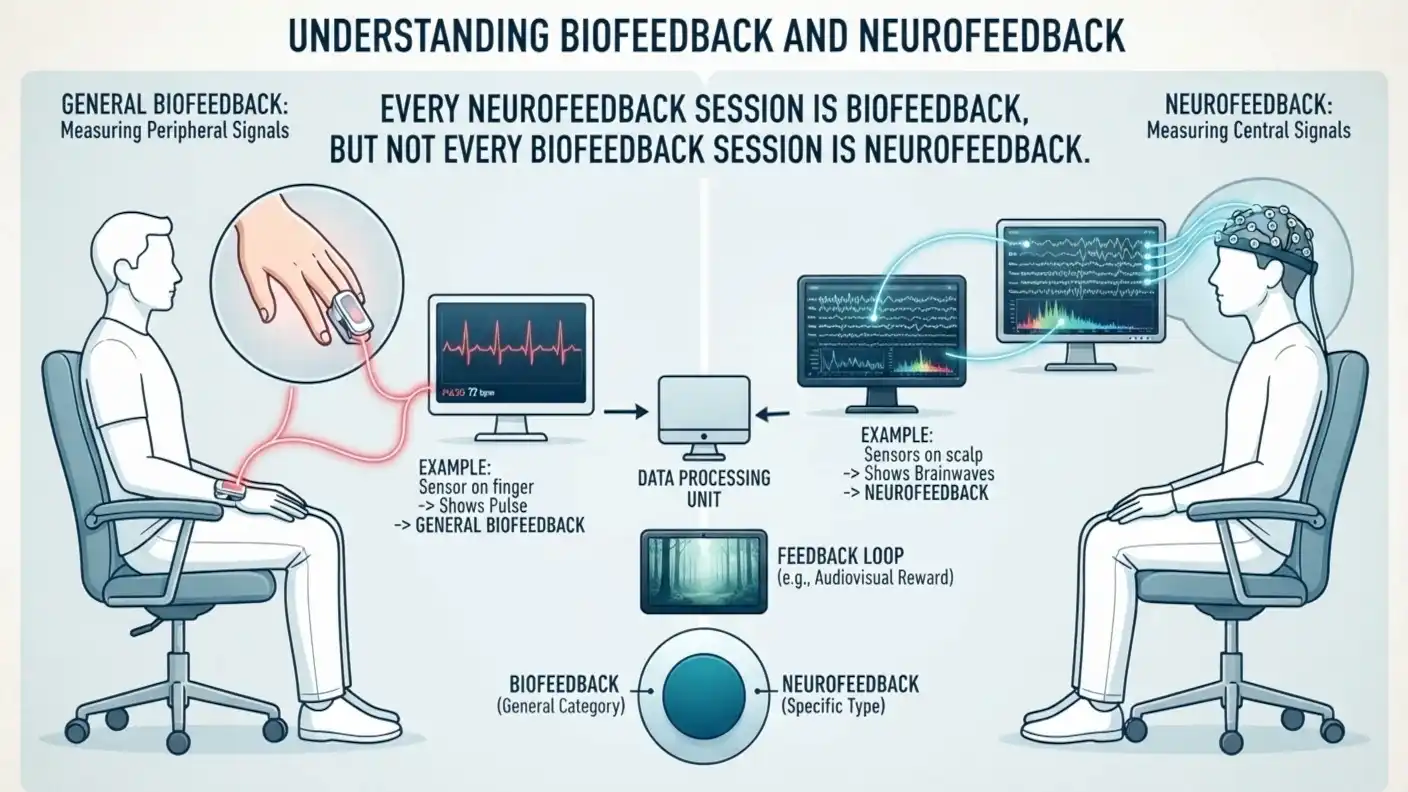
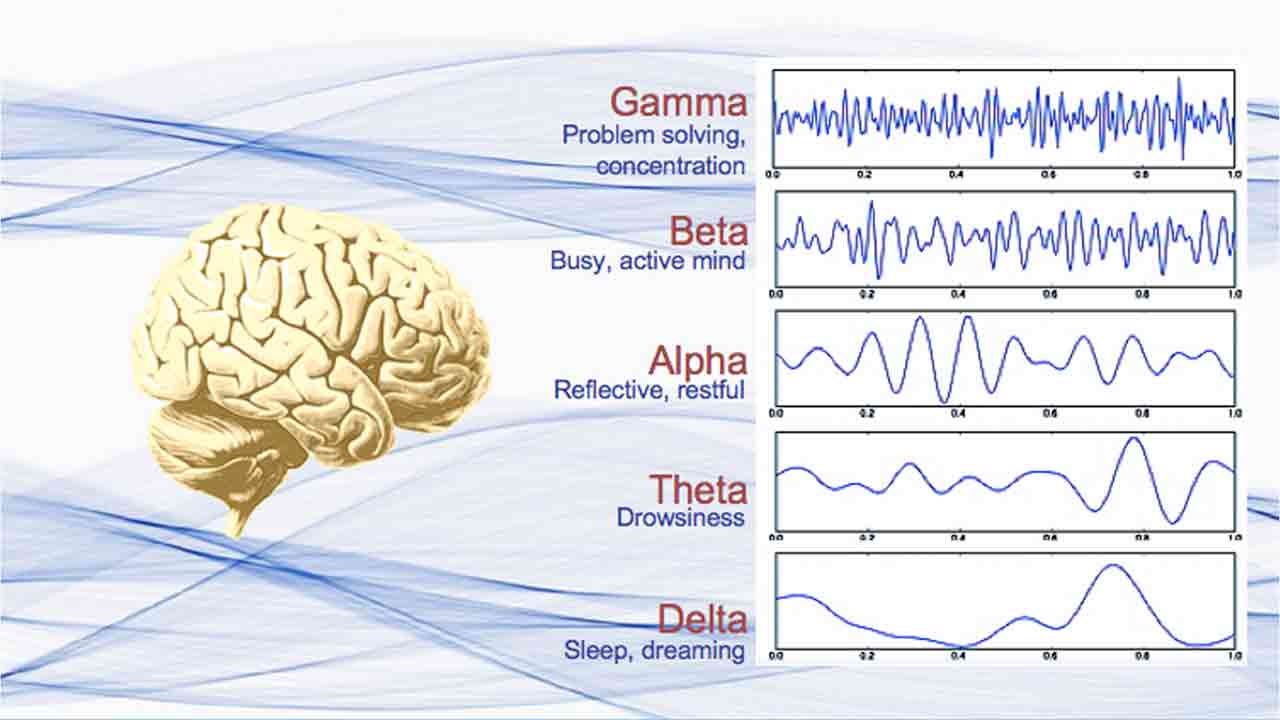
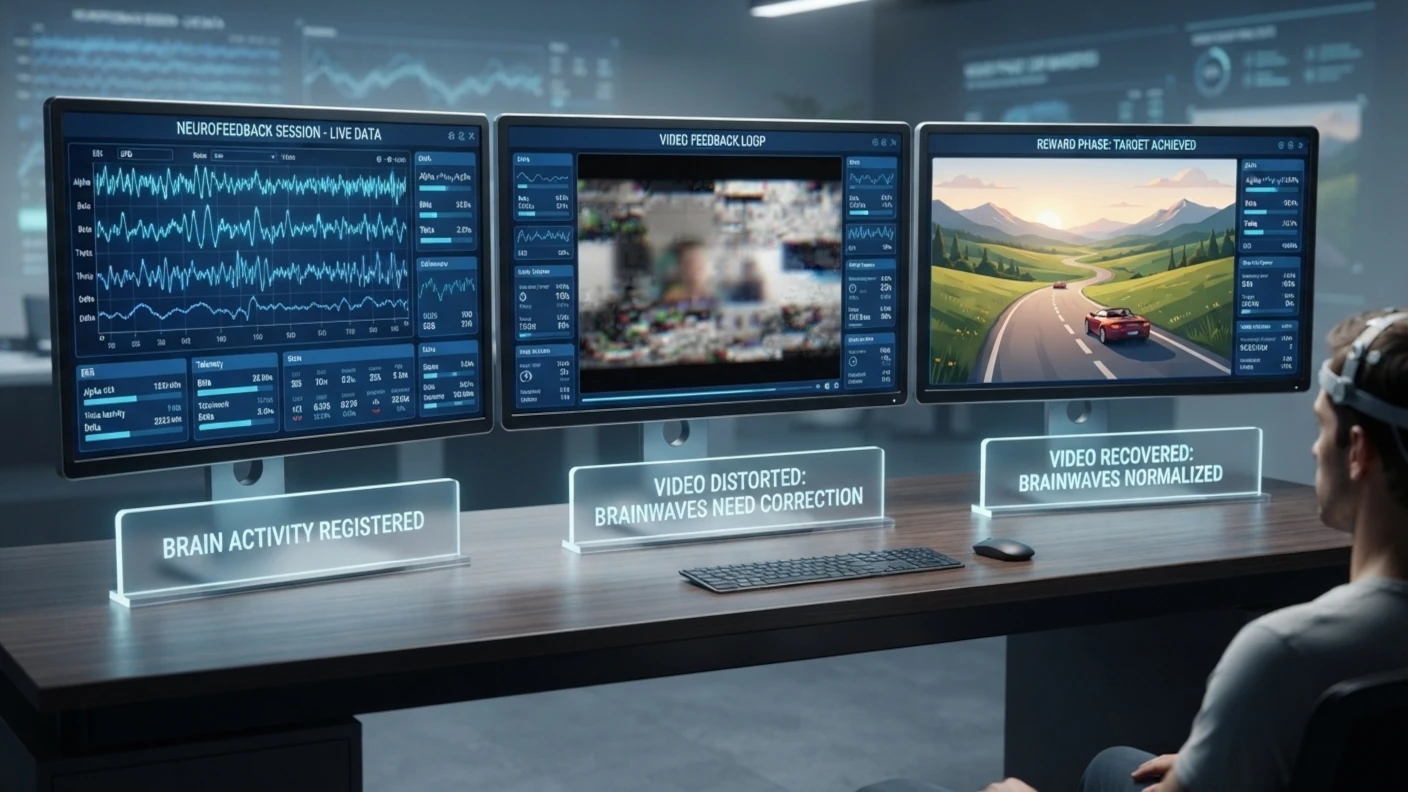
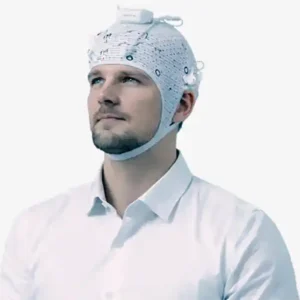
How neurofeedback works comes down to a simple learning principle applied to the brain. EEG sensors on the scalp pick up the tiny electrical rhythms produced by your cortex. Software sorts those rhythms into familiar bands, such as slower theta waves linked to drowsiness and drifting attention, and faster beta waves linked to alert, engaged thinking. The system watches for the pattern you are training toward.
When your brain produces more of the target pattern, the program gives you a reward signal. A video plays smoothly, a tone sounds pleasant, a game piece moves forward, or an image sharpens. When your brain drifts away from the target, the reward fades. Nothing is forced on your brain. It simply gets clear, instant information about which internal state is being encouraged.
That reward loop is operant conditioning, the same process behind most skill learning. You are not consciously steering your brainwaves the way you move an arm. Instead, your brain notices what it was doing in the moments the reward appeared and slowly gets better at returning to that state. Repeat the loop enough times and the pattern becomes more accessible outside the training room. The quality of the feedback matters here: richer audiovisual feedback tends to engage people more than a plain moving bar, which helps the brain stay in the loop long enough to learn.
What a Typical Neurofeedback Session Looks Like
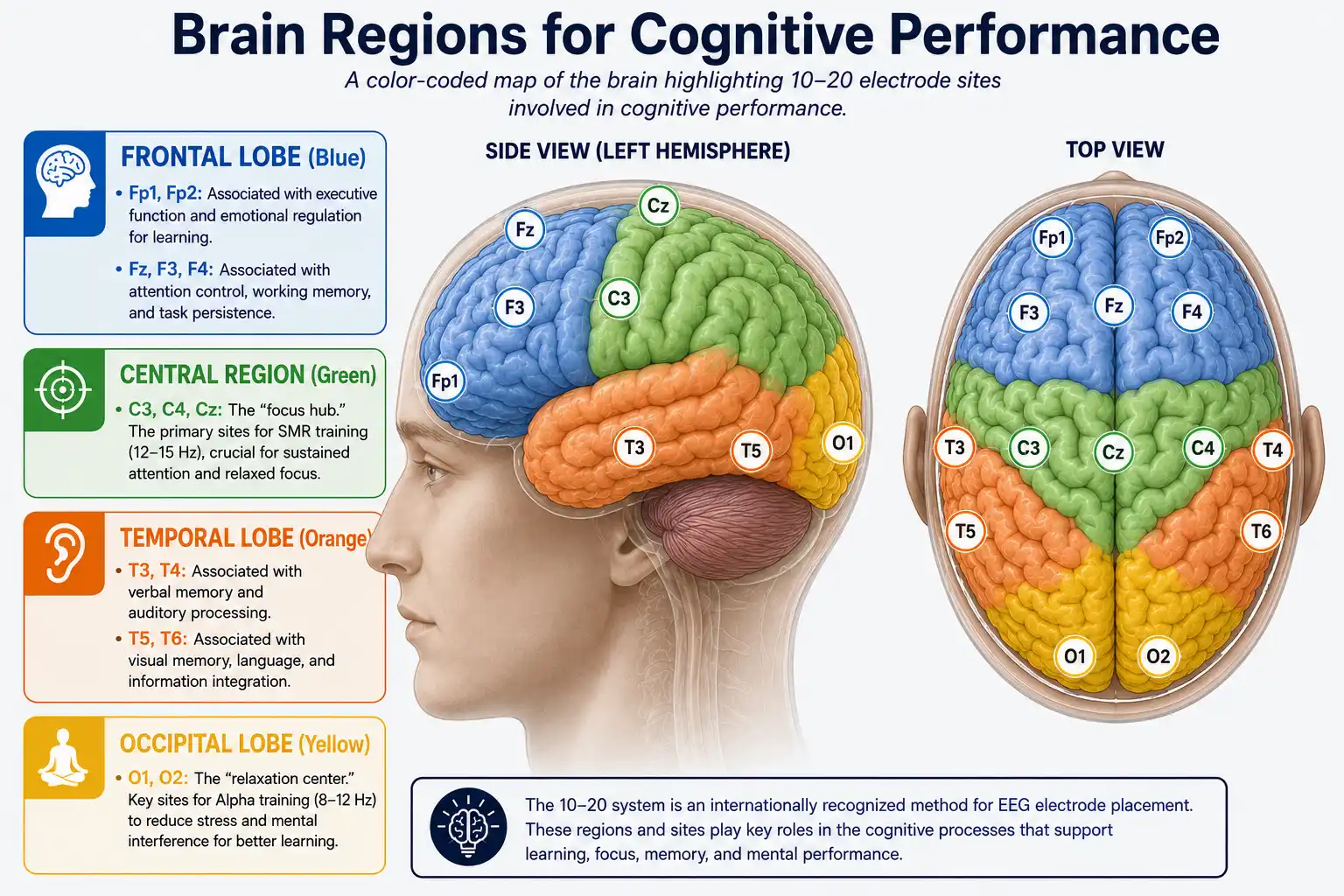
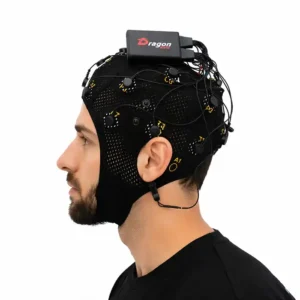
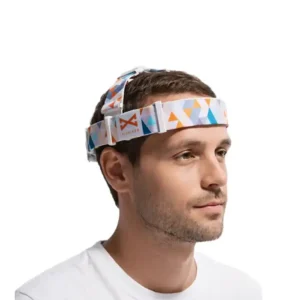
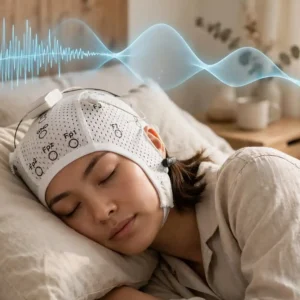
A session is calmer and less dramatic than people expect. A practitioner or a home headset places sensors on specific spots on your scalp, sometimes with a small amount of conductive gel or with dry electrodes on consumer devices. The system takes a short baseline recording so it knows your starting activity. Then the training begins.
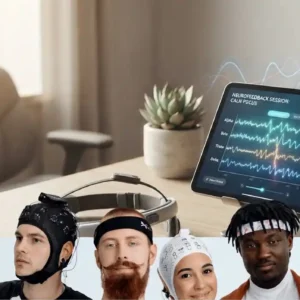
For roughly 30 to 60 minutes, you engage with the feedback. You might watch a film that brightens when you stay focused, or listen to audio that stays smooth while your brain holds the target state. You are not solving puzzles or straining. The work is closer to relaxed attention. Many clinicians track progress with periodic brain maps so you can see how your patterns shift over a course of training.
Here is the part that surprises newcomers: one session is a data point, not a destination. Training is built around repetition, usually a few times a week across weeks or months. The number of sessions varies with your goal and how quickly your brain adapts, but a single visit is better understood as a rep in a longer program than a treatment with same-day results.
What Neurofeedback Is Used For
People turn to neurofeedback for two broad reasons: clinical goals and performance goals. On the clinical side, the most studied application is attention, particularly in the context of ADHD, where the aim is steadier focus and less impulsivity. Researchers have also studied neurofeedback for anxiety, depression, epilepsy, PTSD, insomnia, and recovery after brain injury, with varying amounts of supporting evidence for each.
On the performance side, the goals are different. Athletes, musicians, students, and professionals use neurofeedback to train sustained concentration, calm under pressure, and deeper, more deliberate relaxation. These are not disorders to treat, just skills people want to strengthen, which is why so much of the drug-free self-improvement interest sits here.
A professional body, the Association for Applied Psychophysiology and Biofeedback, helps set practice and training standards in this field, and its existence is a reasonable signal that neurofeedback is treated as a legitimate clinical discipline rather than a fringe gadget. That doesn’t mean every claim about it holds up, which brings us to expectations.
Realistic Expectations and the Learning Curve
This is where honesty matters more than enthusiasm. Neurofeedback asks your brain to learn a new habit, and learning takes time and repetition. Benefits tend to accumulate gradually across many sessions, not in a dramatic breakthrough. If a provider promises a quick fix in one or two visits, treat that as a red flag.
The research picture is genuinely mixed. Many people report real improvements in focus and calm, and some studies are encouraging. But well-controlled trials that compare active training against a convincing sham procedure sometimes find the two produce similar results. Psychology Today notes bluntly that the procedure is often no more effective than a placebo procedure, and that any benefit someone feels could be attributable to the placebo effect. That does not make neurofeedback useless, because feeling calmer and more focused is still a real outcome. It does mean you should go in with grounded expectations and treat neurofeedback as one tool among several, not a replacement for proven care when you have a diagnosed condition.
A sensible way to judge it is to pick a concrete goal, train consistently for a defined stretch, and check whether the thing you care about actually improves. Give it enough sessions to be a fair test, and be willing to stop if nothing changes.
Getting Started at Home vs. With a Clinician
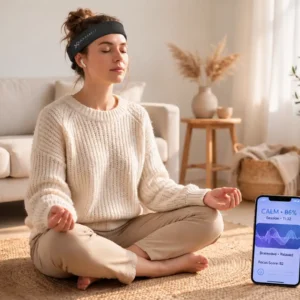
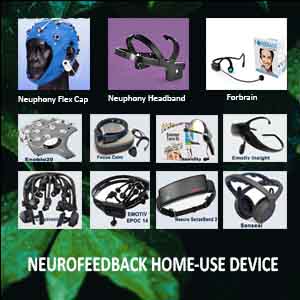
Your starting point depends on what you are after. If your goal is general self-improvement, such as better focus at work or a deeper relaxation practice, a home-use EEG device can be a practical, affordable entry point. Modern consumer headsets handle the sensing and feedback for you, and you can train on your own schedule without booking appointments.
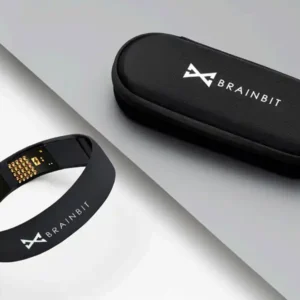
If you want to experiment with brain training before committing to a clinical program, we carefully research and recommend top-rated home-use neurofeedback devices built for exactly this kind of drug-free focus and stress training—explore our curated collection of BrainBit neurofeedback devices here. If you are weighing which device fits your needs, our buyer’s guide to home-use biofeedback devices walks through the practical trade-offs.
If you are dealing with a clinical condition, the calculus changes. A trained clinician can run a proper assessment, choose protocols suited to your situation, track progress with more precise equipment, and coordinate with any other care you are receiving. That expertise is worth the added cost when the stakes are higher than sharpening everyday focus.
Whichever route you choose, start with a clear goal and a plan to measure it. Decide what better would look like, give the training a fair number of sessions, and keep paying attention to whether your real-world experience is improving. Brain training rewards consistency and honest self-assessment more than it rewards hype, so let your own results, not the marketing, decide whether it earns a permanent place in your routine.
Frequently asked questions
Neurofeedback is a type of biofeedback. General biofeedback tracks body signals like heart rate or skin temperature, while neurofeedback specifically measures brainwave activity with EEG sensors.
Most training plans run across many sessions rather than one, often several times a week over a couple of months. The exact number depends on your goal and how your brain responds.
People report benefits, especially for attention and relaxation, but well-controlled studies show those benefits sometimes match a placebo procedure. Treat it as a training tool, not a guaranteed cure.
Yes. Consumer EEG devices let you train focus and relaxation at home. For clinical conditions, start with a trained clinician for safety.
Add a Comment